
Quick Answer
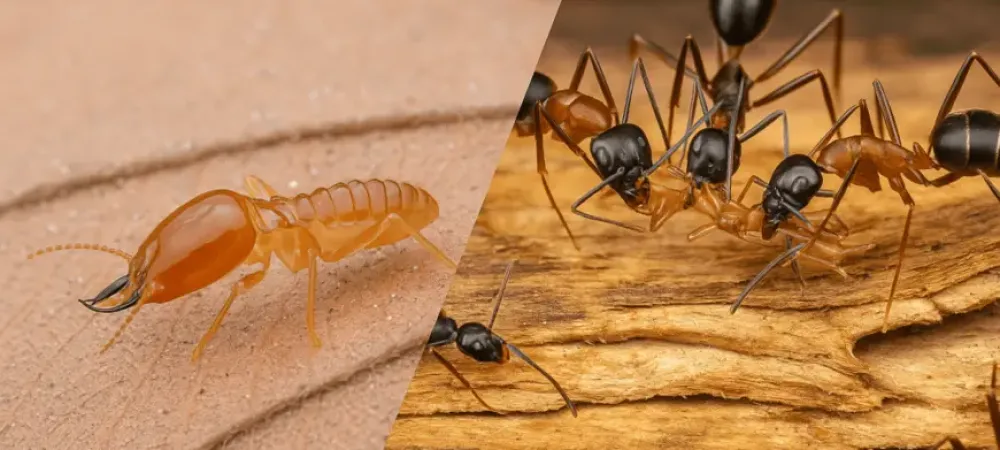
Carpenter ants and termites both damage wood, but they look and behave very differently. Carpenter ants are larger, have a pinched waist, bent antennae, and unequal wings. Termites are smaller, have a straight body with no waist, straight antennae, and equal-length wings. Carpenter ants excavate wood to nest but do not eat it; they push out coarse sawdust-like frass. Termites actually consume wood from the inside and leave behind mud tubes, hollow-sounding wood, and fine powdery droppings. If you are seeing either pest in your New York home, call Pestonix at 917-913-6062 for a free professional inspection.
Introduction
You find a pile of what looks like sawdust near your baseboard. Or you spot a group of winged insects near your window after a warm spring rain. Your stomach drops because you know something is destroying the wood in your home.
But what exactly is it?
This is one of the most common and most important questions homeowners in New York City and Long Island face every spring and summer. Carpenter ants and termites are both wood-destroying insects. They both show up around the same time of year. They can both cause serious structural damage if left untreated. And they both have winged reproductive members that look disturbingly similar to the untrained eye.
But they are completely different pests, and treating one as if it were the other will waste your money, cost you time, and allow the actual damage to continue unchecked.
This guide walks you through exactly how to tell carpenter ants and termites apart, what kind of damage each one causes, and when it is time to stop guessing and call a professional.
Why Getting This Right Matters in New York
New York City and Long Island’s building stock makes this identification question especially urgent. The region has millions of older wood-frame homes, brownstones, and pre-war apartment buildings, exactly the type of structures that both carpenter ants and termites find attractive.
According to the USDA Forest Service, subterranean termites, the species most common in New York, cause more property damage annually than fires, floods, and storms combined in the United States. Carpenter ants, while less destructive than termites, can still compromise structural integrity over years of nesting activity, particularly in wood that is already moisture-damaged.
In both cases, the longer you wait, the more expensive the repair becomes. And the first step toward getting the right treatment is correctly identifying which pest you are actually dealing with.
How to Tell Carpenter Ants and Termites Apart at a Glance
Body Shape: The Fastest Visual Clue
This is the most reliable way to tell these two pests apart without any equipment.
Carpenter ants have a clearly defined, pinched waist, a narrow constriction between their thorax and abdomen that gives them a segmented, three-part body appearance. Their body is typically black, sometimes with reddish or brownish coloring, and worker ants range from about 6 to 12 millimeters in length, making them one of the largest ant species you will encounter in a New York home.
Termites have no visible waist at all. Their body is uniform in width from head to abdomen, creating a straight, almost rectangular profile. Termite workers are creamy white to light brown, soft-bodied, and significantly smaller than carpenter ants, typically around 3 to 4 millimeters long.
The quick test: If the insect has an obvious pinched waist, it is an ant. If the body looks like a straight tube with no narrowing, it is a termite.
Antennae: A Reliable Secondary Clue
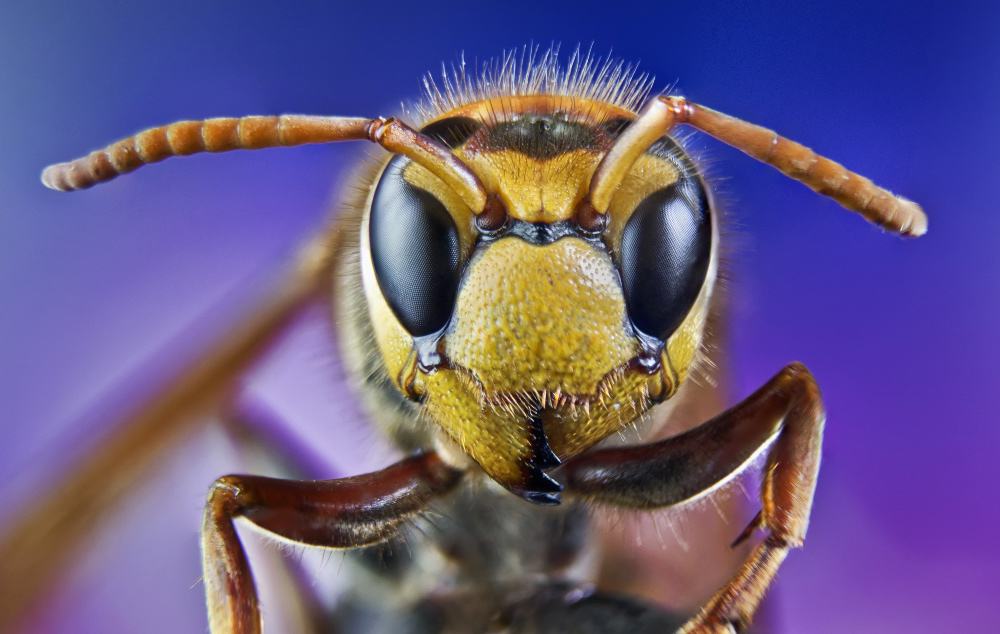
Carpenter ants have elbowed or bent antennae. There is a clear angle in the middle of each antenna, similar to a bent elbow. This characteristic bent antennae is present on all ant species.
Termites have straight, beaded antennae. They look like a string of small round beads running in a straight line from the head with no bend or angle.
This is a reliable identification clue even when body shape is difficult to assess clearly.
Wings: Critical When You See Swarmers
Both carpenter ants and termites produce winged reproductive members, called swarmers, that emerge in spring to start new colonies. This is when most New York homeowners first notice either pest, and it is also the moment of greatest confusion.
Carpenter ant swarmers have two pairs of wings, but the front wings are noticeably longer than the back wings. The wings are clear to slightly smoky in color, and they remain firmly attached to the ant’s body.
Termite swarmers also have two pairs of wings, but both pairs are exactly the same length, equal from front to back. Termite wings are also notably longer relative to the body size, extending well beyond the abdomen. Critically, termite wings detach very easily; finding a pile of equal-length discarded wings near a window or door is one of the most reliable signs of a termite swarm in or near your home.
The quick test: If the wings are equal in length and detached, you are looking at termite evidence. If the wings are unequal and still attached to the insect, it is a carpenter ant swarmer.
Signs of Carpenter Ants vs Termites in Your Home
Seeing the actual insect is not always possible; sometimes the evidence they leave behind is your only clue. Here is how to read that evidence correctly.
Frass: What They Leave Behind
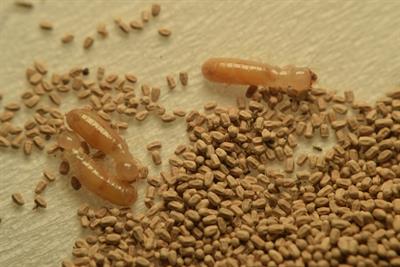
Carpenter ant frass looks like coarse sawdust or wood shavings mixed with insect body parts, soil, and other debris. It is pushed out of the nest galleries through small openings in the wood. If you find a small pile of what looks like rough, mixed debris near a wooden structure, you are almost certainly looking at carpenter ant activity.
Termite frass (from drywood termites) looks completely different. It is very fine, uniform, and pellet-shaped, almost like tiny grains of sand or coffee grounds. Subterranean termites, the species most common in New York, produce mud tubes rather than visible frass, as they use their droppings mixed with soil to build their tunnel systems.
The quick test: Coarse, mixed, sawdust-like debris indicates carpenter ants. Fine uniform pellets or mud tubes indicate termites.
Wood Damage: How Each Pest Destroys Wood
This is where the two pests differ most significantly in terms of the threat they pose to your home.
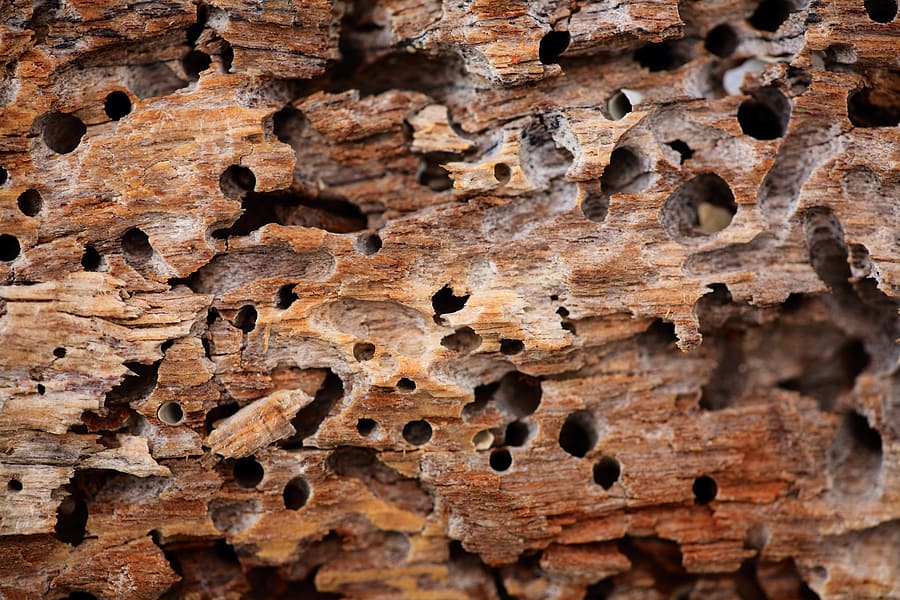
Carpenter ants excavate wood to create smooth, clean galleries for nesting, but they do not eat the wood. They remove it. The galleries carpenter ants create are remarkably smooth and finished-looking, almost as if they were sanded. Carpenter ants prefer wood that is already soft, damp, or partially decayed. A carpenter ant infestation often signals an underlying moisture problem in your home’s structure.
Termites actually consume wood as their food source. Subterranean termites eat along the grain of the wood, leaving behind a honeycomb-like pattern of tunnels filled with soil and their own excrement. When you tap on termite-damaged wood, it sounds hollow because the interior has been consumed while the outer surface remains intact. This is why termite damage is often invisible until it has already become structurally significant.
The critical difference is that carpenter ant damage is extensive but does not consume the wood. Termite damage hollows out the structural integrity of wood from the inside, making it far more dangerous over time.
Mud Tubes: Termites Only
If you find pencil-width tunnels of dried mud running along your foundation walls, basement walls, or floor joists, these are subterranean termite mud tubes. Termites build these earthen tunnels to travel between their underground colonies and the wood they are consuming above ground, maintaining the humidity levels they need to survive.
Carpenter ants never build mud tubes. If you see mud tubes, you have termites. There is no exception.
Sound: Tapping Test
Tap along wooden baseboards, door frames, and floor joists with your knuckle. Solid wood produces a firm, consistent sound. Termite-damaged wood produces a distinctly hollow sound because the interior has been consumed. Carpenter ant galleries also create some hollow sound, but the pattern is different and less uniform than termite-damaged wood.
When Do Carpenter Ants and Termites Appear in NYC?
Both pests follow seasonal patterns in New York, though there is significant overlap in spring that causes the most confusion.
Carpenter ants become active in early spring, typically March and April, as temperatures rise above 50°F. They are most visible in spring and summer when worker ants are actively foraging for food. Swarmers typically emerge from established colonies in late spring, usually between April and June.
Termites swarm in spring, typically April and May in New York, usually triggered by warm temperatures following rain. Subterranean termite swarms are often the first visible sign that a colony has been present and active in or near a structure for a significant period of time.
The spring window when both termite swarmers and carpenter ant swarmers are active simultaneously, typically April and May, is when correct identification is most urgent and most commonly missed.
Which One Is More Dangerous for Your NYC Home?
Both pests cause real damage, but the threat level is different.
Carpenter ants are a serious concern, particularly in Long Island homes and NYC brownstones where moisture issues are common. Left untreated for years, carpenter ant colonies can compromise structural wood significantly. However, carpenter ants damage wood slowly and the damage is usually localized to areas of existing moisture weakness.
Termites are the more dangerous of the two by a significant margin. Subterranean termites are relentless wood consumers that work 24 hours a day, 365 days a year. A mature termite colony can contain hundreds of thousands of workers, all consuming wood simultaneously. The USDA estimates termites cause $5 billion in property damage across the United States every year. This damage is rarely covered by standard homeowner’s insurance.
If you are choosing between the two to treat first, termites represent the greater structural risk and require faster professional intervention.
Can You Treat Carpenter Ants or Termites Yourself?
This is a question worth addressing directly, because the internet is full of DIY solutions for both pests, and most of them are ineffective for established infestations.
Carpenter ants: Consumer-grade ant sprays kill foraging workers but have no effect on the colony itself. The workers that die are simply replaced by the colony. Effective carpenter ant treatment requires locating the satellite nest or nests within the structure, treating gallery networks directly, and identifying and correcting the moisture source that attracted the ants in the first place. This requires professional inspection and professional-grade products.
Termites: DIY termite treatment is essentially ineffective for active subterranean infestations. Consumer liquid treatments cannot reach colony depths. Consumer bait systems exist but require months of monitoring and are not appropriate for active structural infestations. Professional liquid termiticide treatment creating a continuous chemical barrier in the soil around your foundation or professional termite bait station installation is the only reliable approach for active termite problems.
In both cases, attempting DIY treatment while a professional infestation continues growing is the most expensive mistake a homeowner can make.
What to Do If You Are Still Not Sure
If you have found wood damage, winged insects, sawdust-like debris, or any of the other signs described above and you are still not certain which pest you are dealing with, that uncertainty itself is a reason to call a professional immediately.
Here is why: both carpenter ants and termites cause damage that accelerates over time. Every week of uncertainty is a week of continued damage. A professional inspection takes the guesswork out of the equation completely, and most pest control companies, including Pestonix, offer free inspections for exactly this reason.
Do not guess. Do not wait. Get a professional set of eyes on the problem so you can know with certainty what you are dealing with.
Carpenter Ants vs Termites: Quick Reference Summary
| Body shape | Pinched waist | No waist, straight body |
| Antennae | Bent/elbowed | Straight, beaded |
| Wing length | Front wings longer | All wings equal length |
| Wing shedding | Wings stay attached | Wings detach easily |
| Color | Black or black/red | Creamy white to brown |
| Wood damage | Smooth clean galleries | Honeycomb tunnels, hollow wood |
| Frass | Coarse sawdust/debris | Fine pellets or mud tubes |
| Mud tubes | Never | Yes — subterranean termites |
| Eat wood | No — excavate only | Yes — wood is their food |
| Danger level | Moderate | High |
| NYC peak season | March to June | April to May (swarm) |
Frequently Asked Questions
How do I tell carpenter ants from termites?
Look at three things: body shape, antennae, and wings. Carpenter ants have a pinched waist and bent antennae. Termites have a straight body and straight beaded antennae. Winged termites have equal-length wings that detach easily. Winged carpenter ants have unequal wings that stay attached.
Look at three things: body shape, antennae, and wings. Carpenter ants have a pinched waist and bent antennae. Termites have a straight body and straight beaded antennae. Winged termites have equal-length wings that detach easily. Winged carpenter ants have unequal wings that stay attached.
Are carpenter ants as bad as termites?
Both cause structural damage, but termites are significantly more dangerous. Termites consume wood 24 hours a day and can hollow out structural elements over time. Carpenter ants excavate wood more slowly and typically target already-weakened wood. Termite damage is also far less visible until it has already become serious.
Both cause structural damage, but termites are significantly more dangerous. Termites consume wood 24 hours a day and can hollow out structural elements over time. Carpenter ants excavate wood more slowly and typically target already-weakened wood. Termite damage is also far less visible until it has already become serious.
Do carpenter ants eat wood like termites?
No. Carpenter ants excavate wood to create nesting galleries but do not consume it as food. They push the excavated wood out of their galleries as frass. Termites actually eat wood as their primary food source.
No. Carpenter ants excavate wood to create nesting galleries but do not consume it as food. They push the excavated wood out of their galleries as frass. Termites actually eat wood as their primary food source.
What do termite mud tubes look like?
Termite mud tubes are pencil-width tunnels made of soil, wood particles, and termite excrement. They run along foundation walls, basement walls, and wooden structural members, providing termites with protected travel routes between their underground colony and the wood they are consuming.
Termite mud tubes are pencil-width tunnels made of soil, wood particles, and termite excrement. They run along foundation walls, basement walls, and wooden structural members, providing termites with protected travel routes between their underground colony and the wood they are consuming.
I found wings near my window. Is it carpenter ants or termites?
If the wings are all the same length and appear to have detached from the insect, they are almost certainly termite wings. Termite wings detach very easily after swarming. Carpenter ant wings are unequal in length and remain attached to the ant.
If the wings are all the same length and appear to have detached from the insect, they are almost certainly termite wings. Termite wings detach very easily after swarming. Carpenter ant wings are unequal in length and remain attached to the ant.
When should I call a pest control professional for carpenter ants or termites?
Call a pest control professional immediately upon finding any evidence of either pest, including wood damage, frass, mud tubes, swarmers, or live insects inside your home. Neither pest resolves on its own, and both cause damage that accelerates over time. A professional inspection determines exactly what you are dealing with and what treatment is needed.
Call a pest control professional immediately upon finding any evidence of either pest, including wood damage, frass, mud tubes, swarmers, or live insects inside your home. Neither pest resolves on its own, and both cause damage that accelerates over time. A professional inspection determines exactly what you are dealing with and what treatment is needed.
Can carpenter ants and termites be in the same home at the same time?
Yes. Both pests are attracted to wood, and both are common in New York City and Long Island homes. It is entirely possible, though less common, to have both simultaneously, particularly in older homes with multiple moisture issues. A professional inspection covers both.
Yes. Both pests are attracted to wood, and both are common in New York City and Long Island homes. It is entirely possible, though less common, to have both simultaneously, particularly in older homes with multiple moisture issues. A professional inspection covers both.
Conclusion
The difference between carpenter ants and termites matters enormously, both for your peace of mind and your wallet. Misidentifying one as the other means using the wrong treatment, wasting money, and allowing real structural damage to continue undetected.
If you remember nothing else from this guide, remember these three things: termites have a straight body with no waist, equal-length wings that fall off, and build mud tubes. Carpenter ants have a pinched waist, bent antennae, and leave coarse sawdust-like frass. And if you are not certain which one you have, call a professional before the damage gets worse.
At Pestonix, our licensed technicians inspect thousands of New York City and Long Island properties every year for exactly this type of structural pest activity. We identify the pest correctly, treat it with the right professional-grade approach, and make sure you understand exactly what happened and how to prevent it from happening again.
Our Ant Control Services and Structural Insect Control programs are specifically designed for the wood-destroying pest challenges most common in NYC and Long Island’s older building stock, from carpenter ant colony treatment and moisture correction to full termite inspection and liquid barrier treatment.
Call Pestonix at 917-913-6062 or visit pestonix.com for your free inspection today. Same-day service available across Brooklyn, Queens, Manhattan, Bronx, Long Island, Nassau County, and Melville.
Pestonix serves Brooklyn, Queens, Manhattan, Bronx, Long Island, Nassau County, Suffolk County, Melville, and Westchester, NY.