
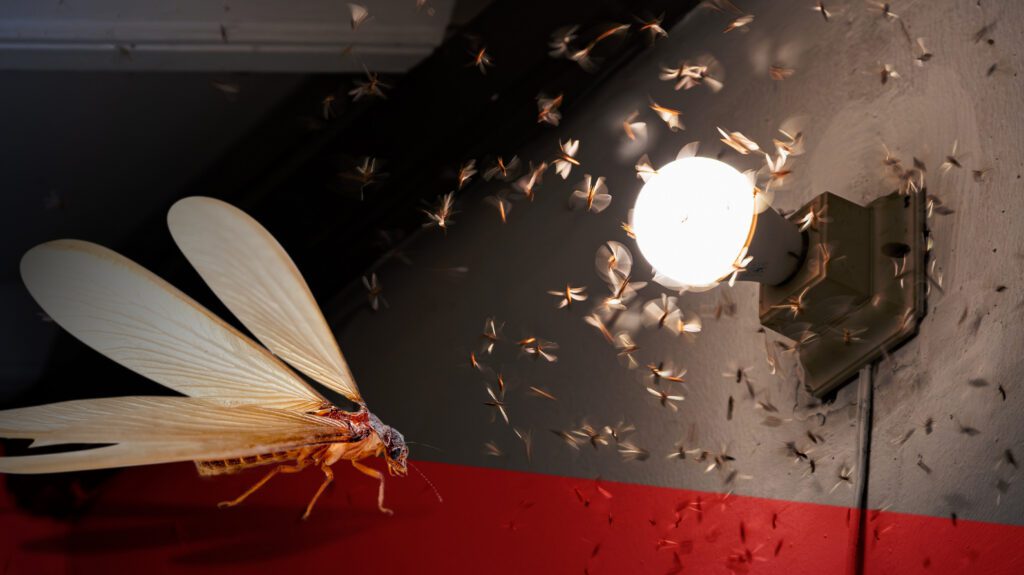
If you’ve spotted a cloud of small winged insects near a window or found a pile of tiny discarded wings on a sill, you may be seeing a termite swarm. In New York, this is a distinctly seasonal event, and knowing when it happens, and why, makes it much easier to figure out what you’re actually looking at.
When Do Termites Swarm in New York?
In New York, eastern subterranean termites typically swarm during spring, generally from late March through June, with activity most often reported in April and May. Swarms usually happen on warm, calm days, often shortly after rainfall. Exact timing varies year to year with local weather and building conditions, so this window is a general pattern rather than a fixed date.
That range comes from a mix of Cornell Cooperative Extension guidance for the New York region and pest management sources that reference Cornell Cooperative Extension of Nassau County’s termite resources. It lines up with the broader pattern for the eastern subterranean termite, the only species that causes meaningful structural damage in New York City and the surrounding boroughs, Long Island, and Westchester County.
When Is Termite Swarm Season in NYC?

“Swarm season” describes a window of weeks, not a single date. Reproductive termites, called swarmers or alates, only leave the colony when conditions line up: a warm enough day, recent rain, and workable humidity. That means the season can start earlier in a mild year and later in a cold, dry one. Swarms can also happen indoors somewhat earlier than outdoors, since termite colonies living inside a heated building are less affected by outdoor temperature swings.
NYC Termite Swarm Calendar
| Month | Typical Swarming Activity | What Homeowners May Notice |
|---|---|---|
| January – February | Uncommon outdoors; occasionally reported indoors in heated structures with an active colony | Rare; if seen, usually inside near warm areas like basements |
| March | Activity can begin in mild years, especially later in the month | Early swarmers or shed wings near windows and doors |
| April | One of the two most commonly reported months for swarming in the region | Swarms on warm days after rain; wings on sills, light fixtures |
| May | The other peak month; activity often continues from April | Continued swarms, especially after spring storms |
| June | Activity tapers off but can still occur, particularly earlier in the month | Later-season swarms, less frequent than April–May |
| July – December | Outdoor swarming is uncommon | Occasional isolated reports; not the typical pattern |
This table reflects general regional patterns described by extension and pest management sources covering the New York metro area. It is not a guarantee of when swarming will happen at any specific address in any specific year.
Why Do Termites Swarm in Spring?
Termites swarm to reproduce and expand. A mature colony produces winged reproductives, called swarmers or alates, that leave the nest in large numbers to mate and attempt to start new colonies elsewhere. Spring conditions in New York, warming soil, rising humidity, and rainfall, create the combination of factors that make a successful flight more likely.
Swarming is a normal part of the termite life cycle, not a sign that something unusual is happening. A colony typically needs several years of growth before it’s mature enough to produce swarmers in meaningful numbers, so a swarm is really evidence of an established colony rather than a brand-new one.
What Triggers Termite Swarming?
Termite swarming in New York is triggered by a combination of warming temperatures, soil moisture, and humidity rather than any single factor. Swarms most often occur on a warm day following rainfall, when conditions reduce the risk of the swarmers drying out during flight.
Temperature
Warming temperatures in spring signal to the colony that outdoor conditions are becoming survivable for winged reproductives. University and extension sources describe this as a general warming trend rather than a precise, universally fixed number, and no single temperature threshold is established as an exact trigger for New York specifically. What’s consistent across sources is that swarms follow a period of sustained warmth, not just one unusually warm afternoon.
Rainfall and Moisture
Rain plays two roles. It raises soil moisture, which the colony and the new pairs of swarmers depend on, and it softens the ground, making it easier for a mated pair to dig in and start a new chamber. Cornell Cooperative Extension and University of Missouri Extension both describe swarming flights as typically following a rain event.
Humidity and Weather Conditions
Swarmers are vulnerable to drying out quickly once they leave the protected environment of the colony. Higher humidity after rain improves their odds of surviving long enough to mate and attempt to establish a new colony. This is also why swarms tend to happen on calm days rather than windy ones, since wind increases moisture loss and makes controlled flight harder.
It’s worth being direct about what the evidence does and doesn’t support here: termites do not swarm after every single rain event, and rain is not a guarantee of a swarm. It’s one part of a combination of conditions that has to line up.
Flying Termites in Spring: What Are You Seeing?
If you suddenly notice small winged insects indoors or near your home’s exterior in spring, it’s a reasonable first guess that you’re seeing a termite swarm, especially if it happens on a warm day after rain. Swarmers are drawn to light, which is why they tend to show up clustered on windows, near light fixtures, or in well-lit rooms. The swarm itself is usually brief, often lasting under an hour, after which the insects shed their wings.
That said, flying termites aren’t the only winged insects active in spring. Flying ants swarm during the same general window and are frequently mistaken for termites. The next section covers how to tell them apart.
Termite Swarmers vs Flying Ants: How to Tell the Difference
Termite swarmers and flying ants can be told apart in a few seconds by checking the antennae, waist, and wings. Termites have straight, beaded antennae, a broad waist with no visible pinch, and four wings of equal length. Flying ants have bent, elbowed antennae, a narrow pinched waist, and two longer front wings paired with two shorter rear wings.
| Feature | Termite Swarmer | Flying Ant |
|---|---|---|
| Antennae | Straight, bead-like segments | Bent or elbowed, with a clear angle |
| Waist | Broad and uniform, body reads as one continuous shape (often described as “hot dog” shaped) | Narrow and pinched, a distinct thin waist between thorax and abdomen |
| Wings | Two pairs, equal in length, extending well past the body | Two pairs, unequal length; front wings noticeably longer than rear wings |
| Wing size | Wings are long relative to the body and shed easily, often found in small piles | Wings are shorter relative to the body and less commonly found shed in piles |
| Body shape | Soft, uniform, cylindrical body | Segmented body with a visibly defined thorax and abdomen |
| Where found | Windowsills, light fixtures, near foundation walls or basement areas | Similar locations; also common near outdoor wood, gardens, and kitchens |
Antennae
This is often the fastest check. Termite antennae are straight, like a short strand of beads. Ant antennae have a clear bend partway along their length, giving them an elbowed look.
Waist
Termites have no real waist at all; the body reads as one continuous shape from thorax to abdomen. Ants have a narrow, pinched connection between the two body sections, which is usually visible even without magnification.
Wings
Both insects have two pairs of wings, but termite wings are equal in length to each other, while an ant’s front wings are noticeably longer than its rear wings.
Body Shape
Put together, a termite swarmer looks soft-bodied and uniform, while a flying ant looks segmented and defined, with a visible thorax-abdomen separation.
If the insects are damaged, dead, or hard to examine closely, collecting a few specimens in a sealed bag or container for a professional to identify is a reliable way to remove the guesswork.
What Does a Termite Swarm Mean for Your Home?
Finding termite swarmers, especially indoors, is a meaningful sign that deserves attention, but it does not automatically mean a home has severe damage. Swarmers indicate that a mature termite colony exists nearby or within the structure. What it means for any individual home depends on where the swarmers were found and what other evidence, like mud tubes or wood damage, is present.
It’s worth separating a few related but distinct ideas clearly:
- Termite swarming season is a seasonal window when reproductive termites take flight.
- General termite activity happens year-round, underground and out of sight, whether or not a swarm has occurred recently.
- Termite damage builds up gradually over time as a colony feeds, and its extent varies widely from home to home.
- Termite colony activity refers to the ongoing presence and feeding of a colony, which continues regardless of swarm season.
Swarmers found outdoors, in a yard or near a tree stump, are less directly concerning than swarmers found indoors, which suggest a colony has established itself within or very close to the structure. Either way, a swarm is a reasonable prompt to look for other signs and consider a professional inspection, rather than an automatic conclusion about the severity of any damage.
Signs of Termites to Look For After a Swarm
After spotting swarmers, or the discarded wings they leave behind, it’s worth checking for other supporting evidence:
- Shed wings: small, translucent, equal-length wings collected in piles near windows, doors, or light fixtures
- Mud tubes: narrow, pencil-width tunnels running along foundation walls, connecting soil to a wood source
- Wood damage: wood that sounds hollow when tapped, or paint that looks bubbled or blistered without an obvious water source
- Structural changes: in more advanced cases, sagging floors or ceilings
Not every sign will be present in every case, and finding one sign doesn’t confirm the severity of a problem on its own. Together, though, they give a much clearer picture than swarmers alone.
What Should You Do If You Find Termite Swarmers?
If you find termite swarmers, especially indoors, the most useful first steps are to avoid disturbing them unnecessarily, collect a few specimens for identification if possible, photograph the location, and check nearby areas for mud tubes or wood damage. From there, a professional termite inspection is the most reliable way to confirm whether an active colony is present and what it means for your home.
A few practical steps:
- Note where you found the swarmers, indoors or outdoors, and near which part of the structure.
- Collect a handful of insects (and any shed wings) in a sealed container if you want a professional identification.
- Take photos of the swarm location, any wings left behind, and any suspicious wood or wall damage nearby.
- Avoid spraying insecticide directly on the swarmers; it won’t affect the underlying colony and can make identification harder.
- Contact a licensed pest control professional for an inspection.
Pestonix offers a full termite control service that includes a structural inspection to locate active colonies and entry points, along with treatment options suited to the property. If you’ve found swarmers, shed wings, or suspect wood damage, that’s a reasonable point to schedule an inspection rather than wait.
How Termite Season Fits Into the NYC Pest Calendar
Termite swarming is one part of a much larger seasonal pattern of pest activity across New York City and the surrounding region. Spring in particular brings a wave of insect activity beyond termites, as warming temperatures and rain create favorable conditions for a range of pests at once. For a broader look at what to expect month by month, our seasonal pest guide for NYC covers how termite activity fits alongside other common seasonal pests and what homeowners can do to prepare throughout the year.
When to Contact a Professional
A professional inspection is worth considering any time you find termite swarmers indoors, discover mud tubes along a foundation, or notice wood that sounds hollow or looks damaged without a clear cause. It’s also reasonable to schedule a routine inspection even without visible signs, particularly for older homes with wood-to-soil contact points, since termite activity underground isn’t always visible from inside the house.
If you’ve spotted swarmers this spring or want to rule out an active colony before it becomes a bigger issue, Pestonix provides licensed termite inspections and treatment across NYC, Long Island, and Westchester County. Reach out to schedule an inspection and get a clear answer about what’s happening at your property.
FAQ Section
When do termites swarm in New York?
Termites in New York, specifically the eastern subterranean termite, typically swarm during spring, generally from late March through June, with the most activity reported in April and May. Exact timing depends on local weather.
When is termite swarm season in NYC?
Swarm season in the NYC region generally spans spring, with the heaviest activity in April and May. This is a typical pattern rather than a fixed schedule, since warm, rainy conditions drive the actual timing each year.
Why do termites swarm in spring?
Termites swarm to reproduce and establish new colonies. Spring provides the combination of warming temperatures, rainfall, and humidity that gives winged reproductives, called swarmers, the best chance of surviving their flight and starting a new colony.
Are flying termites common in spring?
Yes. Spring is the most common season for termite swarms in New York, particularly on warm days following rain. Flying ants are also active during the same general window, which is why identification matters.
How can I tell termite swarmers from flying ants?
Check the antennae, waist, and wings. Termites have straight antennae, a broad, uniform waist, and four wings of equal length. Flying ants have bent antennae, a narrow pinched waist, and front wings that are longer than their rear wings.
What temperature causes termites to swarm?
There isn’t a single, universally established exact temperature that triggers termite swarming. University and extension sources describe swarming as occurring on warm days, often following rain, rather than at one specific degree threshold.
Does finding termite swarmers mean I have termites?
Finding swarmers, especially indoors, indicates that a mature termite colony exists nearby or within the structure. It doesn’t by itself tell you the extent of any damage, but it’s a reliable sign that further investigation is worthwhile.
What should I do if I find termite swarmers inside my home?
Avoid disturbing them more than necessary, photograph the location, collect a few specimens if you can, check for mud tubes or damaged wood nearby, and contact a licensed pest control professional for an inspection.
Are termites active outside swarm season?
Yes. Termite colonies work underground year-round, feeding and expanding regardless of whether a swarm is happening. Swarming is just the visible, reproductive phase of a colony’s activity, not the only time termites are active.