
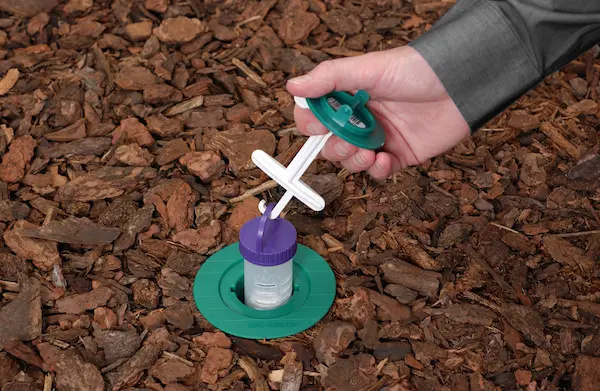
Home improvement stores sell termite bait stakes for around the price of a nice dinner, while a professional termite program can cost several hundred dollars or more. That price gap makes DIY bait stations tempting. But there’s a real difference between the bait systems pest control companies install and the kits you can buy off a shelf, and that difference affects whether the product actually stops termites.
Do DIY Termite Bait Stations Work?
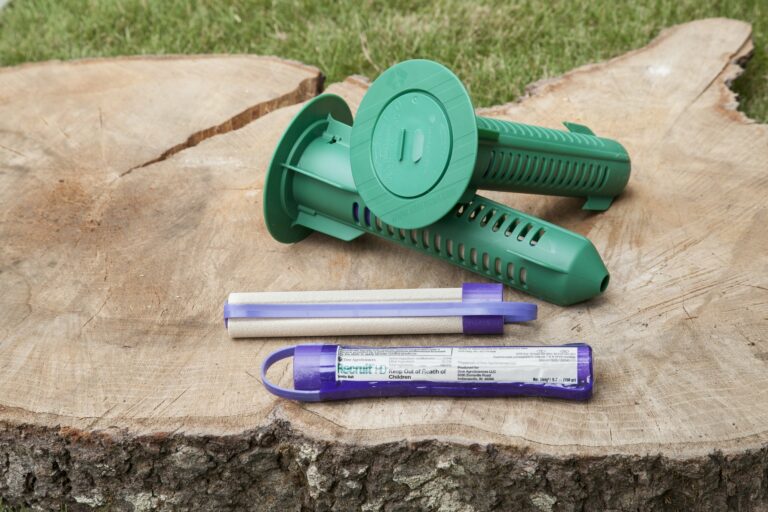
DIY termite bait stations can attract and kill some foraging termites, but research and pest management experts generally agree they are far less reliable than professionally installed and monitored bait systems. Store-bought kits often use faster-acting active ingredients, rely on termites randomly encountering the stations, and are harder to inspect and maintain correctly, all of which limit how well they protect a home on their own.
How Termite Bait Stations Are Supposed to Work
A bait station is a small housing, placed in the ground around a structure, containing a cellulose material such as paper or wood treated with a slow-acting insecticide. Termites forage through soil looking for food, and when they encounter a station, they feed on the bait and carry it back to the colony. Because the insecticide is slow-acting, affected termites do not die immediately. This matters: if the bait killed too quickly, dead termites would pile up near the station, and the rest of the colony would learn to avoid it. The delay lets the toxin spread through the colony through normal feeding and grooming behavior before termites recognize a problem, which is how a bait system can eliminate an entire colony rather than just the termites that happened to feed directly.
This is also why bait stations are described as monitoring and control systems rather than instant fixes. They depend on termites finding the station on their own, feeding on it, and carrying the effect back to the nest, a process that can take months.
DIY Bait Stations vs. Professional Bait Systems
The stations sold at hardware stores and the systems installed by licensed technicians are not the same product tier. The table below summarizes the main differences reported by extension entomologists and industry researchers.
| Factor | DIY / Retail Bait Stations | Professional Bait Systems | Active ingredient | Often a faster-acting stomach poison in older consumer products | Slow-acting insect growth regulator (IGR), designed to reach the whole colony before detection | Monitoring | Left to the homeowner; stations are often small and sealed, making inspection difficult | Scheduled inspections by a licensed technician, typically every few months | Placement | Homeowner estimates spacing and depth | Installed based on trained inspection of termite activity and conducive conditions | Follow-up | No standard process for adding stations or combining with other treatments | Bait can be added, moved, or paired with liquid treatment if activity is found | Species identification | Homeowner must identify the pest correctly on their own | Technician confirms termite species before treatment |
What the Research Actually Shows
Professionally Monitored Systems
The strongest available evidence for bait station effectiveness comes from professionally installed and monitored systems. A University of California field study tracked three professionally installed bait systems across fifteen homes with confirmed termite activity over roughly two years. None of the tracked termite colonies were detected again after being identified through the bait stations, and none of the study homes developed a structural infestation during the evaluation period. That research involved the western subterranean termite in California and licensed pest control operators performing regular inspections, so it speaks to the bait method itself rather than to consumer kits, but it shows that the approach works well when installed and monitored correctly.
Mississippi State University Extension describes properly installed and maintained bait stations as capable of controlling termites indefinitely, offering protection comparable to soil-applied liquid treatments. Their guidance is direct about who should install them: even for homeowners considering the bait station approach, the extension recommends hiring a professional pest control company to do it.
Why DIY Kits Fall Short in Practice
University of Kentucky entomologist Dr. Michael Potter, who has written extensively on termite baiting for both homeowners and the pest control industry, has cautioned that efficacy claims printed on some consumer termite bait packaging have not been independently substantiated. His concern isn’t that baiting as a method fails, since professional systems clearly work, but that a homeowner using a retail kit may not follow label directions closely enough, or may be relying on a product whose real-world performance hasn’t been verified the way professional systems have.
Ask Extension, a service staffed by university extension specialists, gives similar guidance: DIY bait products exist and can be purchased, but an effective bait program requires ongoing surveillance and follow-up, such as adding stations or combining them with a soil-applied treatment. That level of monitoring, the service notes, is generally best handled by a professional pest control company.
Common Problems With DIY Termite Bait Stations
- Termites don’t smell out a bait station from a distance. They have to physically forage into it, so placement and spacing matter more than most homeowners realize.
- Many consumer stations are small and sealed, which makes it hard to check whether termites have actually found them without damaging the station.
- Some retail products use faster-acting ingredients that can cause termites to avoid a station once other termites nearby are affected, rather than carrying the effect back to the full colony.
- Correctly identifying the termite species, and confirming the activity is actually termites rather than ants or another wood pest, is easy to get wrong without training.
- There is no built-in process for escalating treatment if the bait station approach isn’t working, which can let a colony continue undetected.
When DIY Bait Stations Might Make Sense
Extension guidance doesn’t rule out DIY stations entirely. If you want a low-cost way to monitor for termite activity in a yard with no known history of infestation, a retail station checked regularly is better than doing nothing. Where DIY approaches fall short is as the sole line of defense once termite activity is confirmed near or inside a structure. At that point, the ongoing monitoring, correct placement, and ability to escalate treatment that extension sources point to become far more important than the lower upfront cost.
What to Do If You Suspect Termites
If you’ve already found mud tubes, discarded wings, or damaged wood, a DIY bait station is not the place to start. A professional termite inspection confirms whether termites are active, identifies the species, and shows a licensed technician exactly where the colony is entering the structure, information a store-bought kit can’t give you. From there, a professional bait or liquid treatment plan can be matched to what’s actually happening at your property.
Pestonix provides licensed termite inspections and treatment across NYC, Long Island, and Melville. If you’ve spotted signs of termites or just want to confirm your home is protected, our technicians can tell you what’s actually going on before you spend money on a solution that may not fit the problem.
Frequently Asked Questions
Are DIY termite bait stations a waste of money?
Not necessarily, but they work best as a monitoring tool rather than a full treatment plan. For active termite activity near a structure, extension experts consistently recommend professional installation and monitoring instead.
How long do bait stations take to work?
Bait stations depend on foraging termites finding them, which can take weeks to several months. Field research has recorded average bait interception times ranging from roughly six months to a year, depending on the season and location, which is why bait systems are considered a monitoring and long-term control method rather than a fast fix.
Can I install a professional-brand bait system myself?
Systems like Sentricon, Trelona, and Exterra are generally sold and serviced through licensed pest control companies, not as retail products, and their labels typically call for installation and monitoring by a trained applicator.
Do bait stations replace the need for an inspection?
No. Bait stations manage termite activity once it’s identified, but a licensed inspection is what confirms whether termites are present, what species they are, and where they’re entering the structure.
What’s the difference between bait stations and liquid termiticide treatment?
Liquid treatments create a chemical barrier in the soil around a structure, while bait stations rely on termites carrying a slow-acting insecticide back to the colony. Both are considered effective when properly applied, and a professional can advise which fits a given property, or whether a combination makes sense.