
You wake up with red, itchy welts on your arm. You check your mattress and find tiny dark spots along the seams. Your stomach drops. Bed bugs.
If you live in New York City or Long Island, you already know this is not a rare situation. New York consistently ranks among the most bed bug-infested cities in the entire United States. According to Orkin’s 2024 Bed Bug Cities Report, New York City has held a top-5 spot for years. And once bed bugs settle into your apartment or home, they do not leave on their own.
So now you are facing the big question that every New Yorker in this situation eventually asks: heat treatment vs chemical for bed bugs, which should I choose?
This guide breaks it all down honestly, backed by research, and written specifically for New York City and Long Island residents who need real answers, not vague internet advice.
Why Bed Bugs Are Especially Difficult to Eliminate in NYC
Before comparing treatments, it helps to understand why bed bugs are such a persistent problem in New York specifically.
New York’s dense housing, high-rise apartment buildings, multi-family brownstones, and shared walls mean a bed bug problem in one unit can quietly spread to neighbouring units within days. Bed bugs travel through wall voids, electrical outlets, and plumbing gaps. By the time you notice bites, the infestation may already be on multiple floors.
A 2023 study published in the Journal of Medical Entomology found that bed bug populations in urban environments have developed resistance to many common pyrethroid-based pesticides, the exact chemicals used in standard chemical treatments. This is a critical fact that most pest control companies don’t lead with.
This resistance issue is part of why the heat treatment vs chemical for bed bugs debate matters so much in a city like New York.
What Is Heat Treatment for Bed Bugs?
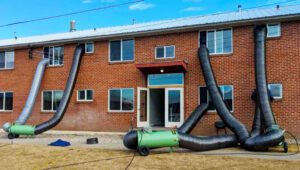
Heat treatment involves raising the temperature of an entire room or home to between 118°F and 122°F and maintaining it for a sustained period, typically 60 to 90 minutes at the target temperature.
Bed bugs cannot survive at these temperatures. Neither can their eggs.
According to Rutgers University research, a single properly executed heat treatment kills bed bugs at all life stages, eggs, nymphs, and adults, in a single visit. This is the single biggest advantage heat treatment has over any chemical method.
How it works in practice:
A professional team brings in industrial heating equipment and fans that circulate hot air throughout the space. Technicians use thermal sensors to monitor temperature in all areas, including inside walls, furniture, and mattresses. The entire process typically takes 6 to 8 hours for a standard apartment.
What heat treatment is best for:
- Severe or widespread infestations
- Situations where chemical resistance is suspected
- People who want a chemical-free solution
- Eliminating bed bugs in a single treatment visit
What Is Chemical Treatment for Bed Bugs?
Chemical treatment uses pesticides, typically a combination of pyrethroids, neonicotinoids, and insect growth regulators, applied to baseboards, furniture, mattress seams, and other harborage areas.
The idea is that bed bugs come into contact with the chemical, either directly or as they travel across treated surfaces, and are killed over time.
The reality of chemical treatment:
Chemical treatments require multiple visits, usually two to three, spaced two weeks apart, to catch newly hatched nymphs that survived the first round. This is because no currently available pesticide reliably kills bed bug eggs.
The CDC and EPA have both acknowledged that pyrethroid resistance in bed bug populations is a growing concern, particularly in urban areas like New York City. A 2017 study in the Journal of Economic Entomology confirmed that New York bed bug populations showed significantly higher resistance to deltamethrin, a common pyrethroid, compared to bed bugs from other regions.
This does not mean chemical treatment never works. When combined with insect growth regulators and non-pyrethroid active ingredients, chemical approaches can still be effective. But they work best for mild to moderate infestations and require strict preparation and cooperation from residents.
What chemical treatment is best for:
- Early-stage or localized infestations
- Budget-conscious situations
- Properties where heat treatment logistics are complicated
- Follow-up prevention after a primary heat treatment
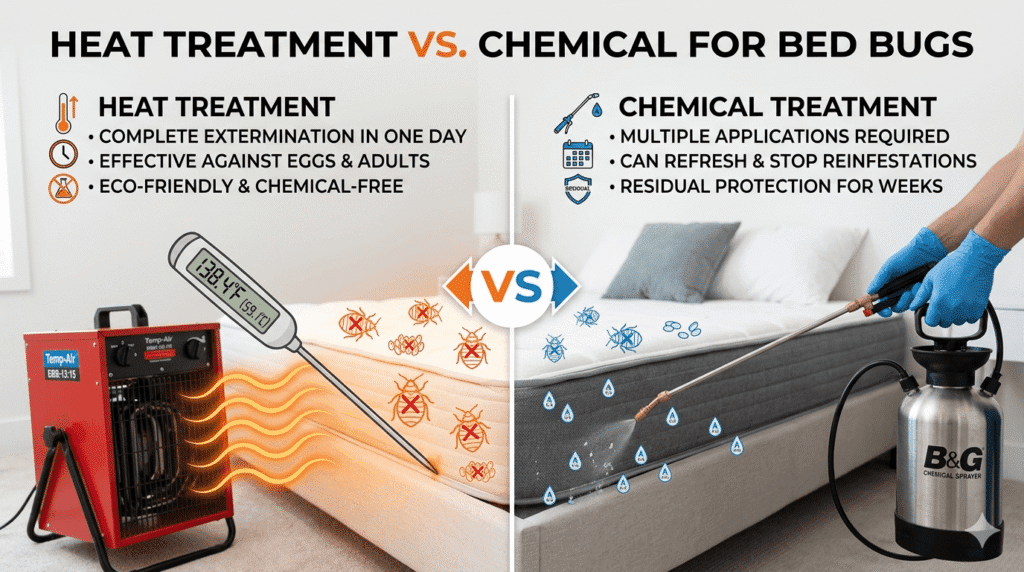
Heat Treatment vs Chemical for Bed Bugs: Direct Comparison
Here is an honest, side-by-side look at both methods based on research and real-world results in NYC and Long Island homes:
Speed of Results: Heat treatment eliminates bed bugs in a single day. Chemical treatment requires multiple visits over several weeks before the infestation is fully resolved.
Effectiveness Against Eggs: Heat kills eggs completely. Chemicals do not reliably penetrate or kill bed bug eggs, which is why multiple treatments are required.
Resistance Issues: Heat cannot be resisted; biology has no defence against sustained high temperatures. Chemical treatments are facing growing resistance in New York’s urban bed bug populations.
Preparation Required: Heat treatment requires moderate preparation, including removing heat-sensitive items such as candles, plants, and certain electronics. Chemical treatment requires extensive preparation, including bagging clothing, clearing clutter, and vacating the property for several hours.
Cost: Heat treatment has a higher upfront cost, typically ranging from $1,000 to $3,500 for a standard New York apartment. Chemical treatment costs less per visit but requires multiple sessions, bringing the total cost closer over time.
Safety Heat treatment is completely chemical-free, ideal for families with young children, elderly residents, or pets. Chemical treatments use pesticides that require careful handling and re-entry waiting periods.
Long-Term Prevention: Both methods benefit from follow-up inspections. Heat treatment often includes a follow-up visit to confirm results. Chemical treatment may also include residual applications that provide some ongoing protection.
What New York Residents Actually Experience
Maria, a resident in a Flatbush apartment building, tried chemical treatment twice after discovering bed bugs. After two rounds of pesticide application and still finding live bugs six weeks later, she switched to heat treatment. One visit later, the problem was gone.
This story is not unusual. Many New York City residents report that chemical treatments provide temporary relief but struggle to fully eliminate infestations in dense, multi-unit buildings where re-infestation from neighbouring units is always possible.
For Long Island homeowners dealing with bed bugs in wood-frame houses with attics and crawl spaces, heat treatment offers a significant advantage, as it penetrates walls and hidden spaces that spray applications cannot reach effectively.
When to Choose Heat Treatment
Choose heat treatment when:
- You have found bed bugs in multiple rooms
- You have already tried chemical treatment without complete success
- You have children, elderly family members, or pets at home
- You want the problem resolved in the shortest possible time
- You live in a NYC apartment building where re-infestation risk is high
When Chemical Treatment Still Makes Sense
Chemical treatment remains a reasonable choice when:
- The infestation is caught very early and is limited to one area
- Budget is a significant constraint
- You are willing to commit to the full multi-visit treatment schedule
- It is used as a preventive measure after heat treatment
The Professional Difference: Why DIY Never Works for Bed Bugs
One important point that research consistently supports is that DIY bed bug treatment almost always fails.
A 2019 study in Pest Management Science found that over-the-counter bed bug sprays and heat guns purchased by consumers rarely reach the temperatures or chemical concentrations needed to eliminate an infestation fully. They may temporarily reduce visible bug activity, but leave eggs and hidden populations intact.
Professional treatment, whether heat or chemical, uses industrial-grade equipment, trained technicians, and follow-up protocols that consumer products cannot replicate.
Pestonix: Professional Bed Bug Treatment in New York City and Long Island
At Pestonix, we have helped hundreds of New York City and Long Island residents resolve bed bug infestations using both heat treatment and targeted chemical treatments, choosing the right method for each property’s specific situation.
We serve homeowners and renters across:
- Pest Control Services in Brooklyn New York: Flatbush, Bed-Stuy, Crown Heights, Bay Ridge
- Pest Control Queens NY: Flushing, Jamaica, Astoria, Jackson Heights
- Pest Control Manhattan NY: Harlem, Midtown, Upper East Side, Hell’s Kitchen
- Pest Control in Bronx: Fordham, Riverdale, Co-op City, Pelham Bay
- Pest Control in Long Island: Nassau County, Suffolk County, Melville, Hempstead
Every treatment begins with a free professional inspection to assess the severity of the infestation, determine the best treatment method for your property, and develop a clear plan to get your home bed bug-free as quickly as possible.
Frequently Asked Questions
How long does heat treatment take for bed bugs?
A standard heat treatment for a one- to two-bedroom apartment takes approximately 6 to 8 hours from setup to completion.
Do I need to throw away my mattress after bed bug treatment?
In most cases, no. Both heat treatment and professional chemical treatment can eliminate bed bugs from mattresses without requiring disposal. Your technician will advise based on the mattress’s condition.
Can bed bugs come back after heat treatment?
Heat treatment eliminates all bed bugs present at the time of treatment. However, re-infestation from neighbouring units is possible in apartment buildings. Pestonix offers follow-up inspections and prevention plans to protect against this.
Is heat treatment safe for my apartment?
Yes. Professional heat treatment is safe for standard home materials, furniture, and electronics when proper preparation is followed. Your technician will provide a full preparation checklist before the treatment day.
How much does bed bug heat treatment cost in NYC?
Costs vary based on the property’s size and the severity of the infestation. Call Pestonix at 917-913-6062 for a free inspection and quote.
Conclusion
When it comes to heat treatment vs chemical treatment for bed bugs in New York City and Long Island, heat treatment wins on speed, effectiveness, and reliability, especially given documented pesticide resistance in NYC’s urban bed bug populations.
Chemical treatment still has a role to play for early-stage infestations or as a follow-up prevention tool, but for anyone dealing with a moderate to severe infestation in a New York apartment or Long Island home, heat treatment is the smarter investment.
Don’t let bed bugs take over your home. Call Pestonix at 917-913-6062 or visit Contact us to schedule your free bed bug inspection today.