
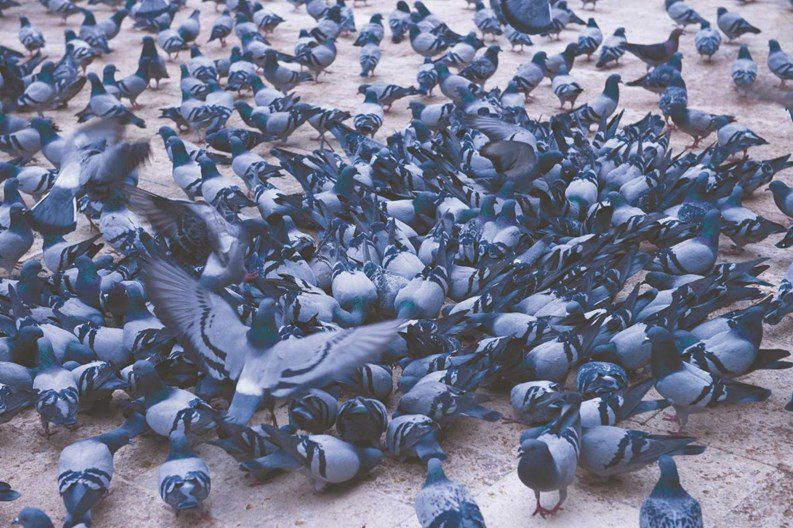
Pigeons look harmless on a sidewalk. On a ledge, balcony, or rooftop above your head, they become a different problem: droppings that stain and corrode, nests that block drains and vents, and a flock that keeps growing because nothing about the spot has changed. Good pigeon control in NYC comes down to three things: knowing the rules, choosing deterrents with real evidence behind them, and fixing the conditions that keep birds coming back.
How Do You Get Rid of Pigeons Legally in NYC?
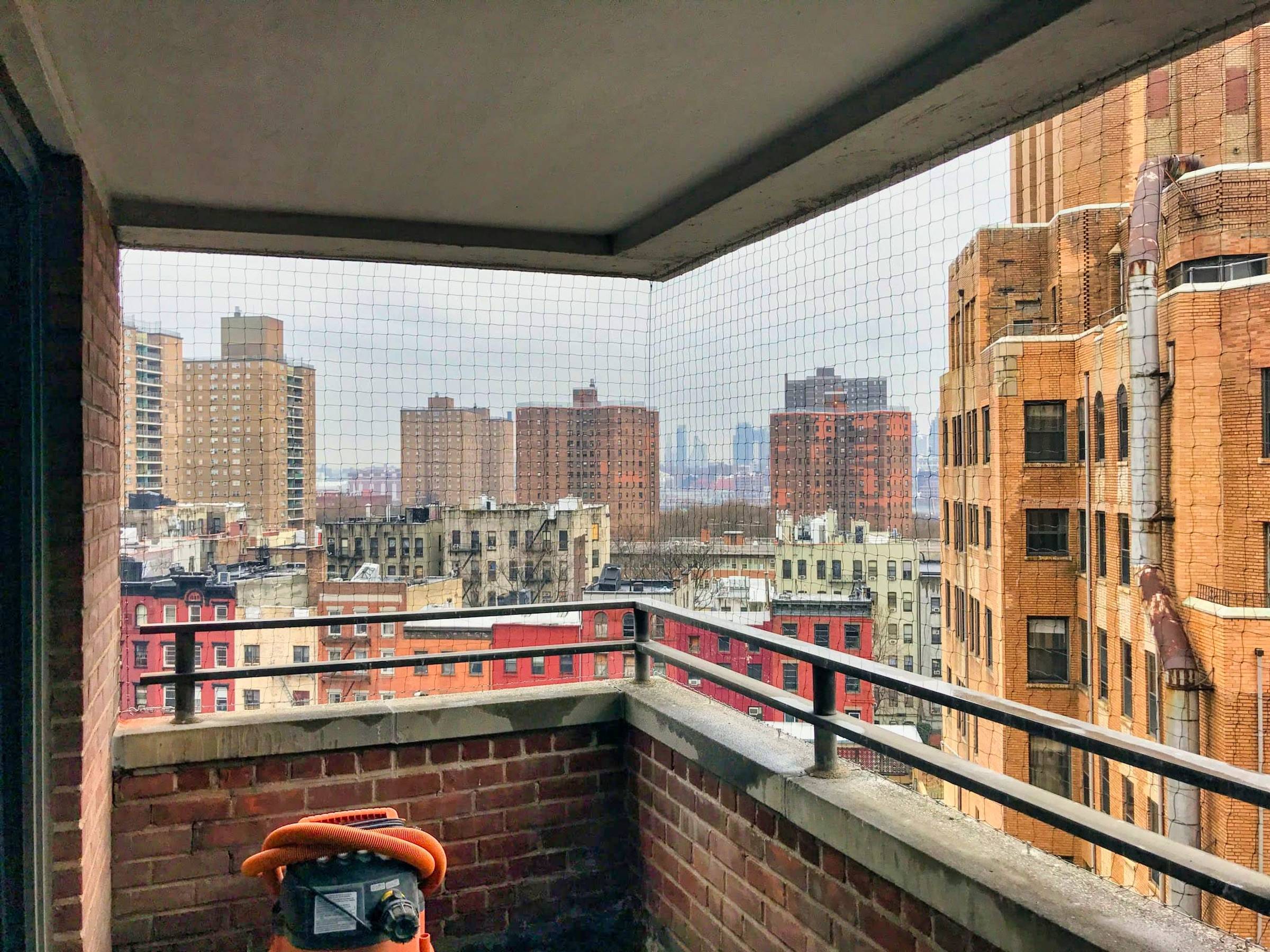
To get rid of pigeons legally in NYC, discourage them without harming them: block nesting and roosting spots with netting, mesh, sloped ledges, or correctly installed spikes, remove food sources, and clean droppings safely. NYC does not ban feeding or keeping pigeons, but property owners must clean up droppings from their property.
Poisons, shooting, and trapping birds to release them elsewhere are poor options in a dense city, and as covered below, they rarely solve the problem anyway. The rules around who is responsible, and what you can attach to a building, depend on the type of property you have.
What NYC and Federal Law Say About Pigeons
Federal law: pigeons are not protected, but other birds are
The rock pigeon (Columba livia), the common city pigeon, appears on the U.S. Fish and Wildlife Service’s list of non-native species that the Migratory Bird Treaty Act does not cover. That law does protect most native birds, along with their nests and eggs.
This matters in practice because native birds, such as doves, can use the same ledges and rooftops. Before you remove a nest or install netting, confirm which species is actually there. The University of Arizona Cooperative Extension warns that bird netting needs expert installation and maintenance to avoid trapping and killing native birds, and that poorly placed spikes can create nesting spots for other birds.
NYC rules: feeding, keeping, and droppings
According to the NYC Health Department, it is not illegal to feed or keep pigeons. The city does require property owners to clean up pigeon droppings on or originating from their property, and anyone can report excessive droppings or unsanitary conditions caused by pigeons through the city’s online complaint process.
Feeding still works against you. Pigeons learn quickly where food is reliably available, and a fed flock stays close. Rules on city park property are set separately by NYC Parks, so check the current rules before feeding birds in a park.
Landmarked buildings and rental buildings
If your building is a designated landmark or sits in a historic district, check with the Landmarks Preservation Commission before attaching netting, spikes, or other hardware to the facade. The LPC says ordinary repairs and maintenance do not need a permit, but most exterior changes to front and rear facades do need review, and anything that physically attaches to historic fabric deserves a question first.
Because the Health Department places the cleanup duty on the property owner, shared roofs, ledges, and courtyards are generally the responsibility of the owner or the co-op or condo board. For problems inside a rental unit, our guide to landlord and tenant pest control responsibilities in NYC apartments explains how to approach it.
Why Pigeons Keep Coming Back
Pigeons are built for city life. They nest on ledges and other flat surfaces, eat seeds, scraps, and garbage, and breed year round, raising multiple broods a year. Pairs stay together and tend to keep returning to the same nest site.
Flocks also use different places for different jobs. According to University of Arizona Extension, a flock may nest and roost in one spot, feed at another, and loaf at a third, sometimes miles apart. That is why a single treated ledge often does not end a problem: the birds still have somewhere else to sleep, eat, and gather.
Pigeon Deterrents Compared: What Works and What Doesn’t
The table below ranks common options from most to least reliable for long-term results. The ranking is our summary of the University of Arizona Extension review of pigeon management methods. That publication does not test the methods head to head, and results depend heavily on installation.
| Rank | Method | What the research says | Best for | Watch out for |
| 1 | Exclusion netting or mesh | Physically blocks pigeons from roosting and nesting areas such as eaves, vents, and alcoves, so it does not depend on scaring birds. | Eaves, vents, courtyards, alcoves, rooftop equipment areas | Needs expert installation and upkeep. Gaps or sagging net can trap or kill birds, including native species. |
| 2 | Sloped ledges or blocked access | Changing a ledge to about a 45 degree angle, or blocking access to it, removes the flat surface pigeons need. | Window ledges, sills, cornices, parapets | Every ledge in the area has to be treated. Landmark rules may apply. |
| 3 | Bird spikes and bird wires | Can stop pigeons from landing on some structures when the right product is correctly installed. | Narrow ledges, signs, beams, railings | Poor or incomplete installation can create nesting spots. Extension specialists call this a job for professionals. |
| 4 | Electric shock tracks | In tests, shocked pigeons were deterred from landing. | Commercial ledges where other options have failed | Raises animal welfare concerns. The idea that a few shocked birds scare off a whole flock has not been shown scientifically. |
| 5 | Sticky or optical gels | Tested gels showed only transient repellency. | Rarely a good choice | Welfare concerns, and sticky substances can harm smaller birds and other animals. |
| 6 | Decoys, reflectors, and lasers | Work for a while, then pigeons get used to them. | Short-term relief while a permanent fix is arranged | Pigeons habituate quickly. Decoys must be moved often to keep any effect. |
| 7 | Sonic and ultrasonic devices | Loud noise works at first, then birds adjust. Pigeons cannot hear ultrasonic frequencies, and testing found no effect on their behavior. | Not recommended | Can affect other animals that hear higher frequencies. |
The pattern is clear. Physical barriers outperform anything that relies on scaring birds, because pigeons adapt to sights and sounds but cannot walk through a net or land on a surface that is not there. Sonic gadgets sit at the bottom of the list for a reason.
Sealing vents, rooflines, and gaps is part of professional pest proofing and exclusion, and it is usually the step that makes other deterrents last.
Why Trapping and Removal Alone Rarely Solve the Problem
It is tempting to trap the birds and take them somewhere else. University of Arizona Extension explains why that does not work well: pigeons that are released miles away often return to their original nest site, and trapping or lethal reduction usually leads to a quick rebound as new birds move into good habitat.
Breeding speed makes it worse. Under the assumptions the extension authors use (two eggs per clutch, six clutches a year, no losses for two years), one mated pair could produce 78 offspring in two years. That is a model, not a count of real NYC flocks, but it shows how quickly numbers recover. Egg oiling can be effective, but it only helps if every egg is found and treated, and egg-prevention bait has had mixed results in city field studies.
Check local codes before any live trapping, since it may not be an allowable method. Long-term success usually comes from reducing food, blocking nesting and roosting spots, and keeping that work up.
Pigeon Droppings: Health Risks and Safe Cleanup
The NYC Health Department lists cryptococcosis, histoplasmosis, and psittacosis as diseases associated with pigeon droppings. People can become infected by breathing in dust that is stirred up while cleaning droppings. Histoplasmosis comes from a fungus that grows in soil and dried bird droppings, and its spores can become airborne when disturbed.
The risk of these diseases is rare. The Health Department says people most at risk are those with compromised immune systems, and that anyone with a compromised immune system should not clean up droppings. University of Arizona Extension adds that for most healthy people, disease risk from contact with pigeons or droppings is low, but cleanup still calls for care.
| Situation | What to do |
| Small, routine cleanup (a windowsill or railing) | Wear disposable gloves and washable clothes. Avoid direct contact, wet the droppings rather than dry-sweeping, and wash your hands and any exposed skin afterward. Use an N95 respirator for outdoor cleanup, as the extension advises. |
| Large cleanup (an air shaft, attic, or heavy buildup) | Wear disposable coveralls, boots, gloves, and a respirator. Soak droppings in water and shovel them rather than using a high-powered hose. Double-bag waste and used materials. For significant buildup and nesting material, this is a job for professionals. |
| Never do this | Do not scrape, power spray, sweep, or vacuum dry droppings or nesting material. It sends spores and fragments into the air. |
Droppings and nesting material can also attract secondary pests such as mites and insects, so leaving a roost uncleaned can create new problems.
A Practical Pigeon Control Plan for NYC Buildings
- Remove the reward. Stop any feeding, keep trash secured, and clean up spilled food and seed around the building.
- Confirm what you have. Make sure the birds are pigeons, and check for nests with eggs or young, especially if other bird species are present.
- Clean up safely. Remove droppings using the precautions above so the area is not a draw and not a hazard.
- Block the roosting and nesting spots. Use netting or mesh over eaves, vents, and alcoves, seal gaps, and slope or cover flat ledges.
- Deter the remaining landing spots. Spikes or wires can help on narrow ledges and railings when properly installed. Avoid relying on sonic devices or decoys.
- Inspect and maintain. Check netting and barriers regularly, especially after storms, and repair gaps quickly.
In larger buildings and commercial properties, a building-wide plan matters more. Because flocks nest, feed, and loaf in different places, a fix on one ledge can simply shift birds to the next untreated one.
When to Call a Professional
DIY steps can handle a single windowsill or a small balcony. Bring in a professional if:
- Pigeons are nesting in vents, eaves, rooflines, or other parts of the structure
- There is heavy droppings buildup or nesting material, especially in enclosed spaces
- Anyone in the building has a weakened immune system
- The ledges are high or hard to reach, or the building is a landmark
- You manage a restaurant, warehouse, or multi-unit property where droppings reach shared or food areas
- Earlier attempts have failed. Our guide to DIY versus professional pest control covers when it is worth making the switch
Pestonix has served NYC and Long Island since 2004. Our humane wildlife removal service covers birds along with raccoons, squirrels, and other wildlife. It starts with an inspection to locate nesting sites and entry points, followed by removal, sealing the structure, and cleanup of droppings and nesting material. 24/7 emergency wildlife response is available across the NYC metro area.
Property managers and business owners can also review our rodent and wildlife management services, or contact our team to talk through a plan for your building.