
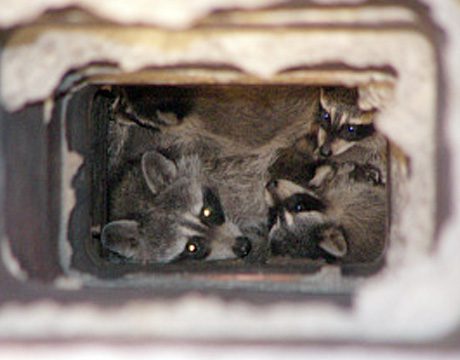
To keep raccoons out of your chimney, install a stainless steel chimney cap fastened to the flue with screws, and keep the damper closed. Then remove what draws raccoons to your property: unsecured trash, outdoor pet food and easy access to your roof.
A chimney looks a lot like a hollow tree to a raccoon. It is dark, dry and high off the ground, which makes it an appealing place for a female to raise young. Trash bins give raccoons the food that keeps them nearby. Fixing both problems is the most reliable way to stop raccoons from settling in.
This guide covers the signs of raccoons in a chimney, a prevention checklist, what to do if they are already inside, how to secure trash in NYC, the health risks and when to call a professional.
Why Raccoons Choose Chimneys

Raccoons live in every borough of New York City and are active at night and sometimes during the day. NYC’s wildlife program notes that they live across the city, from parks to dense neighborhoods.
Chimneys without a cap are easy to enter, and raccoons are strong climbers. They scale trees, downspouts and building corners to reach the roof. The NYS Department of Environmental Conservation (DEC) says raccoon litters of one to seven young are born in April and May. According to NYC’s wildlife guidance, kits start leaving the den after about 8 to 12 weeks. That means a chimney in spring can hold a mother and her young for weeks.
Signs of Raccoons in Your Chimney
- Heavy thumping, scratching or shifting sounds in the flue, often at night
- Chirping or crying sounds from young, especially in spring
- A rattling damper or debris falling into the fireplace
- A strong animal odor from the fireplace
- Droppings on the roof or near the chimney. CDC-linked research has documented raccoon latrines on chimney ledges.
- Raccoons seen on the roof, or torn vents and damaged roof trim
If the noise happens mostly in daylight and sounds like scampering, you may have squirrels instead. See our guide on squirrels in the attic in NYC to tell them apart.
How to Keep Raccoons Out of Your Chimney
Use this exclusion checklist:
| Weak point | Fix | Why it matters |
|---|---|---|
| Open or damaged chimney top | Install a commercial stainless steel chimney cap, secured with screws | Wildlife agencies recommend this as the best way to keep raccoons out |
| Open damper | Keep the damper closed | A closed damper stops an animal that gets into the flue from entering the room |
| Easy roof access | Trim branches that touch or overhang the roof | Raccoons use branches as ramps |
| Climbable building corners | Where practical, wrap corners with sheet metal at least 3 feet square | Makes climbing harder |
| Attic and roof vents | Cover with heavy-gauge metal screens | Raccoons tear thin screens |
| Gaps under decks, porches and sheds | Seal or block potential den spots | NYC wildlife guidance advises sealing potential den locations |
| Older, worn caps | Inspect yearly and after storms | A loose cap is as bad as none |
New York’s Department of Health also advises capping your chimney with screens as part of rabies prevention. If you are not comfortable working on a roof, ask a licensed chimney professional to fit the cap. Our pest proofing and exclusion service focuses on sealing the roofline and vent gaps that raccoons exploit.
If Raccoons Are Already in the Chimney
Do:
- Listen for young. In spring, assume a mother and kits may be inside.
- Call a licensed wildlife professional if you hear young or cannot tell.
- Cap the chimney only after you are sure every animal is out.
Do not:
- Light a fire or use smoke. Wildlife agencies warn it can kill the animals and still leaves you with a removal problem.
- Open the damper to see inside. A frightened raccoon can end up in your living room.
- Seal the top while animals are inside. The DEC cautions against permanently sealing entrances before verifying that all animals are out, especially in spring.
- Try to trap raccoons yourself. Raccoons are protected by law in New York, and trapping them for hire requires a DEC Nuisance Wildlife Control Operator license.
Some homeowners wait a few weeks for a mother to move her young. Strong smells or a loud radio placed near the damper at dusk are sometimes used to encourage a mother to leave. These steps are not reliable, and they should not be used when babies are present.
Nests and debris can also block the flue, which is a fire and carbon monoxide risk when a fireplace or heating system vents through it. Have the chimney inspected before using it again.
How to Keep Raccoons Out of Your Trash Areas
Raccoons are scavengers, and open garbage is a reliable meal. Wildlife agencies call proper food and garbage management essential. Use these steps:
- Use a lidded bin that latches. Add a bungee cord, clamp or lock if raccoons can flip the lid.
- Anchor outdoor bins to a fence, post or concrete pad so they cannot be tipped.
- Keep trash indoors or in a garage until pickup if you can.
- Put trash out close to pickup time, within DSNY’s rules, not the night before when you can avoid it.
- Keep pet food and bird seed indoors, and clean up spills.
- Keep compost enclosed, and leave meat and bones out of it.
NYC rule: The Department of Sanitation requires buildings with one to nine residential units to put trash out in bins of 55 gallons or less with secure lids. The Official NYC Bin became the required bin for these properties in June 2026. Check DSNY’s containerization page for current rules.
Open trash also draws rats. If you see signs of them, see our rat and mouse elimination service. If you rent and the trash area or roof is shared, our guide on landlord vs tenant pest control in NYC explains who is responsible.
Raccoon Health Risks
Rabies. In NYC, rabies is found mostly in raccoons. As of May 2026, NYC Health had confirmed rabies in eight animals that year, seven of them raccoons in Queens, Brooklyn and Staten Island. Seeing a raccoon during the day does not mean it is rabid, since it may just be looking for food. Do not approach or feed raccoons, keep pets’ rabies vaccinations current, and report any bite to NYC Health’s Animal Bite Unit (646-364-1799) or through 311, then seek medical care.
Raccoon roundworm. The CDC says raccoon roundworm can infect people and dogs and can be severe. Raccoons defecate in shared spots called latrines, and eggs in the droppings can live in the environment for years. The DEC notes that roundworm infects most raccoons in New York at some point in their lives. Children are at higher risk because they may put contaminated hands or objects in their mouths.
If you find droppings, do not sweep or vacuum them dry. Keep children and pets away, and use gloves and an N95 respirator for cleanup in a confined space. Wipe surfaces with a damp sponge and hot, soapy water, and remove contaminated material in sealed bags.
Raccoon Activity by Season
| Time of year | What raccoons are doing | What you should do |
|---|---|---|
| Late winter to early spring | Females look for safe dens ahead of birth | Install or repair the chimney cap and screen vents before April |
| April to May | Litters are born in dens, including chimneys and attics | Do not seal anything. Listen for young and call a professional |
| Early summer | Kits stay in the den for about 8 to 12 weeks, then follow the mother out | Wait for family to leave or have them removed, then seal |
| Late summer to early fall | Young raccoons spread out and look for new territories | Secure trash and pet food, and check roof access |
When to Call a Professional
Call a licensed wildlife professional if:
- You hear young animals
- You are unsure whether anyone is still inside
- You find droppings or a latrine
- The cap is missing or damaged and animals are active
- Raccoons keep returning after you fix the trash
Ask whether the company holds a DEC Nuisance Wildlife Control Operator license, how it checks for young before sealing, what it will seal, and what it guarantees. DEC publishes a searchable list of licensed operators.
Raccoon Removal and Prevention With Pestonix
If you need raccoon removal in NYC, our humane wildlife removal service begins with a detailed property inspection to find nesting areas, entry points and wildlife activity. After removal, technicians seal structural gaps, vents and rooflines with professional exclusion materials, and Integrated Pest Management helps keep animals from returning. It is part of our wider rodent and wildlife management service.
We serve Manhattan, Brooklyn, Queens, the Bronx, Staten Island, Long Island, Nassau County and Westchester, with same-day and 24/7 service. Our rodent and wildlife service includes a 3-Month No-Pest Guarantee, and inspections come with an upfront quote.
Hearing noises in your chimney? Book a free inspection or call 917-913-6062 (NYC) or 631-560-2166 (Long Island).
Frequently Asked Questions
How do I keep raccoons out of my chimney?
Install a stainless steel chimney cap fastened with screws and keep the damper closed. Trim branches near the roof, screen attic vents and secure your trash.
What does a raccoon in the chimney sound like?
Expect heavy thumping, scratching and shifting, often at night. In spring you may also hear chirping or crying from young.
Should I light a fire to get raccoons out?
No. Smoke and fire can kill the animals and do not solve the problem. Opening the damper can also let a raccoon into your home.
Is a chimney cap enough to keep raccoons away?
It stops them from entering the flue, but raccoons will find other openings if trash and roof access are not addressed. Screen vents and seal the roofline too.
Do raccoons in the chimney have rabies?
Usually not, but raccoons are the most common rabies carriers in NYC, so avoid contact. Do not assume a daytime raccoon is rabid, and report any bite to NYC Health.
How long do baby raccoons stay in a chimney?
Kits are born in April and May and typically leave the den after about 8 to 12 weeks. Call a professional rather than trying to remove them yourself.