
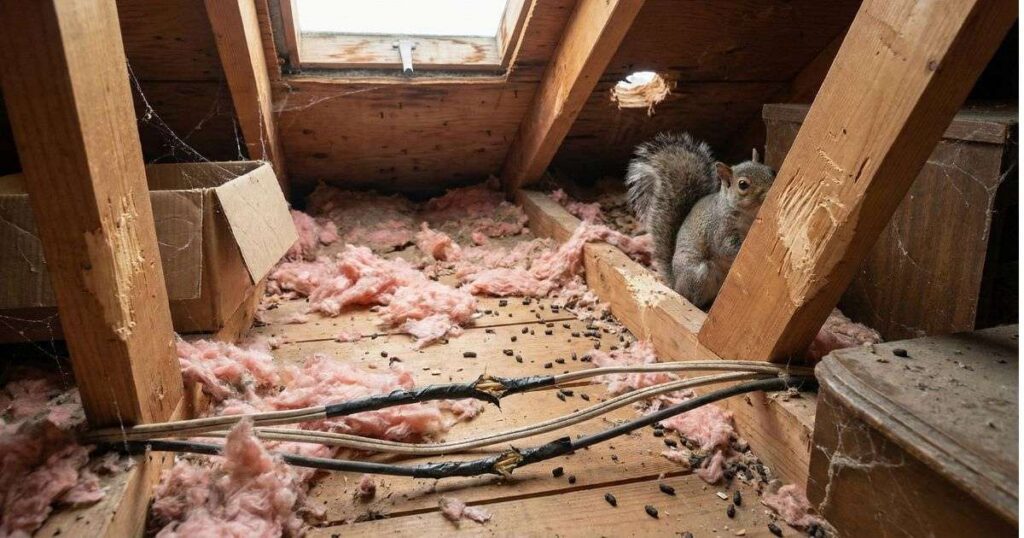
You probably have squirrels in your attic if you hear scratching, scampering or rolling sounds during the day, especially around dawn and dusk, and you find chewed openings near the roofline, nesting debris or gnawed wiring. Squirrels are active in daylight, while mice, rats and raccoons mostly move at night. That timing is the quickest clue.
Eastern gray squirrels are common across NYC and Long Island. Tall street trees, rowhouse rooflines, brownstone cornices and suburban roofs with easy tree access give them plenty of ways in. Once a female finds a warm, dry attic, she may raise a litter there.
This guide covers how to confirm squirrels, the risks they create, what to do and avoid right now, and how humane removal and exclusion work in New York.
How to Know If You Have Squirrels in Your Attic
Look for these signs, and treat two or three together as a strong indicator:
- Daytime noise. Scampering, scratching, rolling (like a nut being pushed across a floor) and occasional thumps, often near sunrise and late afternoon.
- Activity at the roofline. Squirrels going in or out near soffits, fascia boards, roof edges, vents or the gap where a roof meets a wall.
- Chewed openings. Gnawed wood, bent vent covers or torn screens around the roof edge.
- Nesting material. Leaves, twigs, shredded insulation or paper in the attic.
- Droppings and stains. Droppings near the entry point or along beams, and urine staining or odor on insulation or ceilings.
- Gnawed items. Chewed wood, stored boxes or wiring.
Squirrel, mouse, rat or raccoon?
| Animal | Most active | What you usually hear | Other clues |
|---|---|---|---|
| Gray squirrel | Daytime, peaks at dawn and late afternoon | Scampering, scratching, rolling, thumps | Seen at the roofline, chewed roof edge, leaf and twig nests |
| Mouse | Night | Light, quick scratching inside walls | Small droppings, gnaw marks, shredded nesting material |
| Rat | Night | Heavier thumping, gnawing, scurrying | Larger droppings, gnawing on hard materials |
| Raccoon | Night | Slow, heavy, deliberate steps | Torn insulation, damaged vents |
Flying squirrels are nocturnal and can also nest in attics, so night noise does not completely rule squirrels out. If you are unsure which animal you have, our guide on telling rats from mice explains the sounds and droppings of the two most common rodent culprits.
Why Squirrels Move Into NYC Attics
An attic is warm, dry and safe from predators, which makes it a better nursery than a tree cavity or leaf nest. Gray squirrels usually breed twice a year. Sources vary on the exact months. The Alabama Cooperative Extension System puts the two periods in roughly February to March and July to August, with two to four young per litter, while other wildlife sources place them a little earlier or later depending on weather and food supply.
In practice, assume young could be present from late winter through spring, and again from mid-summer into early fall. That matters because it changes how and when removal should be done.
Where Squirrels Get In
Squirrels can squeeze through openings only a couple of inches wide and will chew to widen smaller ones. In NYC and Long Island homes, check these spots first:
- The joint where a roof meets a wall, or where two attached buildings meet
- Soffits, fascia boards and roof returns
- Ridge, gable and attic vents with weak or missing screens
- Uncapped or damaged chimneys
- Cornices and dormer edges on older brownstones and rowhouses
- Utility lines and trim near the roof
Tree limbs close to the roof act as a bridge. Our when to call pest control guide also notes that Long Island’s suburban homes with roof access are common targets for attic wildlife.
Risks of Squirrels in the Attic
Electrical and fire risk
Squirrels gnaw constantly because their incisors never stop growing. Chewed insulation can expose a live wire, and arcing from damaged wiring can ignite nearby insulation or wood. NFPA research on home electrical fires identifies arcing as the leading ignition factor. You may see claims that rodents cause a fixed percentage of house fires, but fire agencies do not publish a reliable figure, so we do not rely on one. The practical advice is simple: if squirrels have been in your attic, have a licensed electrician inspect accessible wiring.
Structural and insulation damage
Squirrels chew wood, vents and roof trim, and they tear and soil insulation. Urine and droppings can soak into insulation, which reduces its effectiveness and can cause odors. The longer they stay, the more likely a simple exclusion job turns into a cleanup and repair job.
Health and hygiene
Droppings, urine and nesting material can contaminate attic insulation and the air in the space. Squirrels can also bring fleas and mites into a home. Avoid sweeping or vacuuming droppings yourself, because that can spread particles.
Rabies is rarely a concern with squirrels. The CDC says small rodents such as squirrels are almost never found to be infected with rabies and have not been known to cause human rabies in the United States. In a CDC review of surveillance from 1995 to 2010, only 9 of 21,977 squirrels submitted for testing (0.04%) were rabid. A bite or scratch still needs care: wash the wound with soap and water and contact a healthcare provider.
What to Do If You Hear Squirrels (and What Not to Do)
Do:
- Note the times of day you hear the noise and any spots where you see animals entering.
- Look at the roofline and vents from the outside for chewed or damaged areas.
- Keep children and pets away from attic access.
- Call a licensed wildlife professional for an inspection.
- Ask an electrician to check attic wiring once the animals are gone.
Do not:
- Seal the entry hole right away. If a mother is outside, she may chew through again. If young are inside, they can be trapped and die.
- Enter the attic without protection or disturb a nest.
- Try to handle or move baby squirrels.
- Use poison. It does not suit squirrels and creates a hazard for pets, children and other wildlife.
How Humane Squirrel Removal Works
A good removal plan has several steps, because trapping alone does not stop new squirrels from moving in.
- Inspection. The technician checks the roofline, vents, chimney, soffits and attic to find entry points, nests and damage.
- Species and young check. Confirming which animal is present, and whether there are young, decides the method and timing.
- Humane removal. This usually means live trapping or one-way exclusion devices that let squirrels leave but not return. The work is timed around litters so that no young are left behind.
- Sealing. Entry points are closed with durable materials, such as metal flashing or heavy-gauge mesh, so squirrels cannot chew back in.
- Cleanup and repair. Droppings, soiled insulation and damage may need attention. Ask whether this is included or handled separately.
- Follow-up. A recheck confirms that repairs hold and activity has stopped.
Who is allowed to remove squirrels in New York?
In New York, a person who traps or removes wildlife for a fee needs a Nuisance Wildlife Control Operator license from the state Department of Environmental Conservation (DEC). DEC publishes a searchable list of licensed operators, so you can check a company before you hire them.
How to Keep Squirrels Out for Good
Once squirrels are out, exclusion keeps them out:
- Seal gaps with metal, not foam or caulk alone, since squirrels chew through soft materials.
- Fit chimney caps and cover vents with sturdy screens.
- Repair damaged roof edges, flashing and soffits promptly.
- Trim branches that touch or hang over the roof.
- Inspect the roofline after storms and once a year, before breeding seasons.
Our pest proofing and exclusion service focuses on sealing the openings that let wildlife and rodents in. If mice are also part of the picture, see our guide to getting rid of mice in NYC apartments.
Questions to Ask Before You Hire a Squirrel Removal Company
- Do you hold a DEC Nuisance Wildlife Control Operator license, and can I verify it?
- How do you check for young before sealing any opening?
- Which removal method will you use, and is it humane?
- Will you seal every entry point, and with what materials?
- Is cleanup included, or handled separately?
- What is covered if squirrels return?
- Can I get a written quote?
If you rent, the attic may be a shared or landlord-controlled space. See our guide on landlord vs tenant pest control in NYC to understand who handles it.
Squirrel Removal With Pestonix
Pestonix runs a humane wildlife removal service that starts with a property inspection to locate nesting areas, entry points and wildlife activity before any trapping begins. After removal, technicians seal structural gaps, vents and rooflines with professional exclusion materials, and Integrated Pest Management is used to help keep wildlife from coming back. This sits within our broader rodent and wildlife management service.
We serve Manhattan, Brooklyn, Queens, the Bronx, Staten Island, Long Island and Westchester, with same-day and 24/7 service. Rodent and wildlife service includes our 3-Month No-Pest Guarantee, and inspections come with an upfront quote.
Hearing noises in your attic? Book a free inspection or call 917-913-6062 (NYC) or 631-560-2166 (Long Island).
Frequently Asked Questions
How do I know if I have squirrels in my attic?
Listen for scratching, scampering or rolling sounds during the day, especially at dawn and dusk. Check the roofline for chewed openings, and look for leaf and twig nests, droppings and gnawed wiring.
What time of day are squirrels active in an attic?
Gray squirrels are active during the day and peak in the early morning and late afternoon. Mice, rats and raccoons are mostly nocturnal, which helps tell them apart.
Is it safe to leave squirrels in the attic?
No. They can chew wiring and insulation, contaminate the space with droppings and urine, and raise litters that make removal harder. Have an electrician check wiring after they are gone.
Can I seal the hole myself?
Not before checking for young. Sealing an active entry point can trap animals inside or leave babies without their mother. Remove the animals first, then seal.
Do squirrels carry rabies?
Very rarely. The CDC says small rodents like squirrels are almost never found to be rabid. Still, wash any bite or scratch with soap and water and contact a healthcare provider.
How much does squirrel removal cost in NYC?
It depends on how many entry points there are, whether young are present and how much damage needs repair. Pestonix provides a free inspection and an upfront quote.