
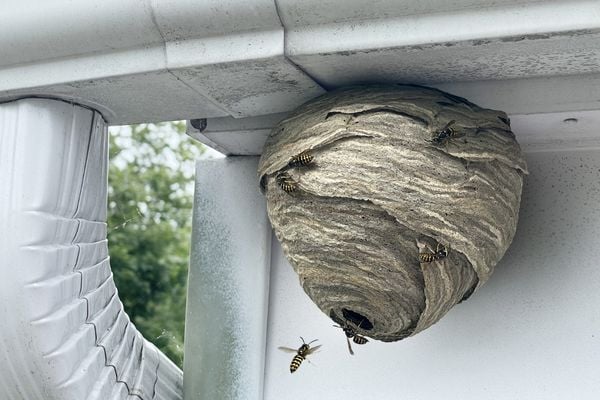
If you have just found a wasp nest, what to do first is simple: nothing sudden. Most stings happen when people swat, spray, or bump a nest they did not know was there. A calm first few minutes matters more than any product you can buy.
The second thing to know is that bees and wasps are not handled the same way. A honey bee colony is usually relocated. A wasp nest is usually removed, or sometimes left alone. This guide covers how to tell which situation you are in, how far away to stay, what not to do, and how NYC’s rules affect who has to deal with it.
What Should I Do If I Find a Wasp Nest?

Stay calm, move away, and leave the nest alone. Keep children and pets back, and note where the nest is and how big it looks. A small nest away from foot traffic can sometimes be left alone. Call a professional if it is hidden, underground, large, or near a door or walkway.
- Walk away slowly. Do not swat, run, or flail. If wasps follow, keep walking directly away until they lose interest.
- Keep children and pets away from the area.
- From at least 10 to 15 feet away, note where the nest is, what it looks like, and where the wasps fly in and out.
- Take a photo using zoom, not by getting closer.
- Decide whether to leave it, relocate it (bees), or have it removed (wasps), using the checklist below.
Safety Distance: How Far Away Is Far Enough?
Stinging insects defend a zone around their nest, and the bigger the colony, the bigger and fiercer that zone, according to Penn State Extension. There is no single safe number for every nest, but extension guidance gives useful working distances.
| Situation | Distance guidance | Why it matters |
| Watching a nest to learn where the wasps travel | At least 10 to 15 feet away, and stay out of their flight path | Wasps use a busy, predictable path in and out of the nest. Standing in it invites stings. |
| Working near a nest (professionals, or a DIY treatment of a small nest) | About 15 to 20 feet away at night, with light sources set up to draw insects away from you | Penn State says ready-to-use wasp sprays reach about 15 to 20 feet, and the more distance you keep, the lower the sting risk. |
| Standing under a nest | Do not | University of Kentucky Extension notes that standing directly under a nest increases the risk of being stung. |
| Children and pets | Keep well away from the area until the nest is dealt with | Rowdy play and curious pets are an easy way to trigger defensive stings. |
Wasps and yellowjackets foraging away from the nest are usually not defensive and rarely sting unless they are trapped or crushed against skin. A wasp at your picnic table is a different situation from a wasp guarding a nest.
Bee Nest or Wasp Nest? The Relocate vs. Remove Checklist
This is the most important decision. Honey bees are managed insects, and beekeeping is legal in NYC. Wasps are not. Use the table to match what you found to the usual best move. If you cannot tell from a distance, see our guide to wasps, hornets, and yellowjackets.
| What you found | What it looks like | Usual best move | Who to call |
| Honey bee swarm | A large cluster of fuzzy bees resting in the open, such as on a branch, fence, or parked bike. They are between homes. | Relocate. Leave it alone and keep your distance. A beekeeper can collect it. | NYC Health says to call 911 for a swarm. The NYC Beekeepers Association also takes swarm reports. |
| Honey bee colony in a wall, roof, or tree hollow | Steady traffic of fuzzy, golden-brown bees through one opening. Wax comb and honey inside. | Relocate if possible. It means opening the structure and repairing it, and the old nest must come out. | A beekeeper who does structural removals. A pest professional if none is available. |
| Bumble bee nest | Large, round, fuzzy bees using a small hole in the ground, a leaf pile, or a cavity. | Usually leave it alone. The colony dies off over winter. Get help only if it is in a high-traffic spot. | A professional, if it is in the way |
| Carpenter bees | Shiny, hairless abdomens and round, dime-sized holes in exposed wood with sawdust below. | This is a wood-protection job, not a nest removal. | A carpenter bee specialist (page linked below) |
| Small paper wasp nest | An open umbrella of cells under an eave, railing, or door frame, a few inches across. | Remove. Early-season nests are the easiest. DIY works only in narrow cases (see below). | A professional if it is high, near people, or anyone is allergic |
| Yellowjacket or hornet nest | A gray or tan enclosed paper nest, or a hole in the ground, wall, or attic with heavy traffic. | Remove, by a professional. Do not approach. | A pest professional |
| Not sure | You cannot identify it from a safe distance. | Stay back and identify before acting. | A pest professional |
Fuzzy and round usually means bee. Smooth, narrow-waisted, and shiny usually means wasp. Our page on carpenter bee control covers the wood-boring look-alikes.
What NOT to Do
- Do not swat, flail, or run in circles. Stings release an alarm pheromone that draws more wasps. Wash a stung area quickly with soap and water.
- Do not knock down, hose, or spray a nest from close range. University of Kentucky Extension says folk remedies like dousing a nest with a garden hose seldom work and often lead to multiple stings.
- Do not use gasoline, kerosene, or fire. Penn State Extension calls this far more dangerous than appropriate insecticides, because fuels are toxic and fire can spread.
- Do not seal the outside exit of a nest in a wall, or plug a hole in the ground. Wasps can chew inward or find another way out, sometimes into the living space.
- Do not climb a ladder or lean out a window to reach a nest. Combining heights with an angry colony is how small problems become emergencies. In NYC, that includes nests on fire escapes, upper ledges, and window air conditioners.
- Do not rely on decoy nests. Penn State Extension reports no clear evidence that they prevent nesting.
- Do not spray a honey bee swarm or colony. Honey bees are often relocatable, and killing a large colony inside a wall creates a different problem. Call a beekeeper first.
- Do not attempt DIY removal if anyone in the household is allergic to stings.
DIY Wasp Nest Removal Risks
Extension specialists do not say you can never do it yourself. They do say the risks are real and that many people underestimate them.
- Stings. Stinging insects can recognize and target the face, and Penn State notes that some yellowjackets can even spray venom at the eyes through a bee veil. No protective clothing is completely sting-proof.
- Allergy. University of Kentucky Extension reports that about two million Americans are hypersensitive to stinging insect venom, and that allergic reactions account for roughly 225,000 emergency room visits a year in the U.S.
- Heights. Many nests sit under eaves or soffits, which means a ladder in the middle of a defended zone.
- Product and technique mistakes. The label controls how a product can be used and where. Foams and liquids can damage wood, drywall, or electrical components if used in walls.
- Incomplete removal. A dead nest left in a wall or attic can attract scavenging insects, and very large nests can rot, causing odor or staining.
Penn State Extension’s practical bottom line: if you know you are allergic, do not try it yourself. Hiring a professional shifts the sting risk to a trained technician, and companies generally carry liability insurance for property damage during treatment.
If you still decide to handle a small nest yourself
Penn State describes a narrow case where DIY is reasonable: a small, exposed, open-comb paper wasp nest that you can reach from the ground. In that case:
- Plan in daylight but treat at night, when wasps fly less and see poorly. Use a red light, placed away from where you stand.
- Use a ready-to-use wasp and hornet spray labeled for the job, and read the label first. Stay 15 to 20 feet away, out of the flight path.
- Wear long sleeves, long pants, closed shoes, chemical-resistant gloves, and eye protection, and plan an escape route.
- Confirm the colony is dead the next day, then knock down and destroy the nest after the spray has dried.
Do not use this approach for enclosed nests, nests underground or inside walls, large nests, or anything you cannot identify.
Should You Just Leave It Alone?
Sometimes, yes. Penn State and the NYC Health Department both note that a nest does not always need to be removed. Timing matters:
- A nest found in fall will die naturally soon. Paper wasps, yellowjackets, and hornets build new colonies each year, and colonies die off over winter.
- A nest found in May or June may look small, but it can become a problem by August or September. Dealing with it early, while it is small, is safer and easier.
- A nest near a business entrance, walkway, or play area is likely to be disturbed sooner or later, so waiting is not a good plan.
Leaving a nest in a quiet spot also keeps useful insects around, since wasps hunt caterpillars and flies. Our NYC seasonal pest guide shows why a small spring nest can be a much bigger July problem.
NYC Rules: Who Has to Deal With a Nest?
In NYC, calling the city will not get a nest removed. According to NYC311, the City does not accept requests to eliminate bees, wasps (including hornets), or their hives, and the Health Department will not remove them from private property. Residential and commercial property owners are required to remove most wasps and bees from their own property. You can file a complaint about a private or commercial property owner who does not, or about a beekeeper whose bees are a nuisance.
The NYC Health Department adds that a hive or nest does not need to be removed unless it is a direct threat to people, and that property owners must remove nuisance bees or wasps that threaten health. For a bee swarm, its guidance is to call 911. NYC Parks does not take complaints about nests in trees, and removing a nest from a City tree requires a Tree Work Permit to hire an insect relocator.
If you rent, a nest in a shared area is generally the owner’s responsibility, while a nest on your own balcony may depend on your lease. Our guide to landlord and tenant pest control responsibilities in NYC apartments explains how to raise it.
When to Call an Exterminator for Bees or Wasps
For wasps and yellowjackets, call a professional if any of these apply:
- The nest is underground, in a wall, in an attic, or otherwise hidden
- It is enclosed in a paper shell or larger than a hand
- It is high up, or you would need a ladder
- It is near a door, walkway, balcony, or play area
- Anyone in the household has a sting allergy, or has already been stung several times
- You are not sure what it is
For honey bees, the first call is usually not an exterminator. A beekeeper can often relocate a swarm or a colony. If one cannot, a pest professional may need to remove the colony, and either way the old comb has to come out of a wall, because wax and honey can rot or ferment inside it. Our guide to DIY versus professional pest control covers the general decision.
If someone is stung, remove any stinger quickly, wash with soap and water, and apply a cold compress. Call 911 for hives, trouble breathing or swallowing, swelling of the face or throat, dizziness, or a rapid pulse.
Getting Help in NYC
If you have wasps or yellowjackets, Pestonix can handle it. Our yellow jacket control service starts by locating the nest, whether it is aerial, in a wall void, or underground, then treating the colony at its source rather than only the wasps you can see. Treatments are family-safe and pet-safe, and they are backed by our 3-Month No-Pest Guarantee. Licensed technicians serve NYC and Long Island, with 24/7 emergency support.
If you are not sure whether you are dealing with bees or wasps, or you just want a professional opinion before touching anything, contact our team and we will help you work out the next step.
Frequently Asked Questions
Should I knock down a wasp nest myself?
Usually not. Extension specialists warn that knocking down or hosing a nest often leads to multiple stings. Only a small, exposed, early-season paper wasp nest is a reasonable DIY case, and only if nobody in the household is allergic.
How far away should I stay from a wasp nest?
Watch from at least 10 to 15 feet away and stay out of the wasps’ flight path. The larger the colony, the larger the area they defend. Never stand directly under a nest.
Will a wasp nest go away on its own?
Often, yes. Paper wasp, yellowjacket, and hornet colonies die off over winter, and old nests are not reused. A nest found in fall will naturally perish soon, but one found in spring or early summer can grow quickly, so do not assume it will stay small.
Who removes a wasp nest in NYC? Does the city do it?
No. NYC311 says the City does not accept requests to eliminate bees, wasps, or hives, and property owners are required to remove most wasps and bees from their own property. You can complain through 311 about an owner who does not.
What should I do if I find a bee swarm?
Leave it alone and keep your distance. The NYC Health Department’s guidance is to call 911 for a swarm. Swarming honey bees are usually looking for a new home and often move on, or a beekeeper can collect them.
Can honey bees be relocated instead of killed?
Often yes. Beekeepers relocate swarms, and some do structural removals from walls. Expect to pay for a wall removal, and clarify beforehand who will handle the repairs afterward.
What time of day is best to deal with a nest?
Extension specialists recommend treating at night, when wasps fly less and see poorly. This is also why most nest work is best left to professionals, who plan the approach, flight path, and escape route.