
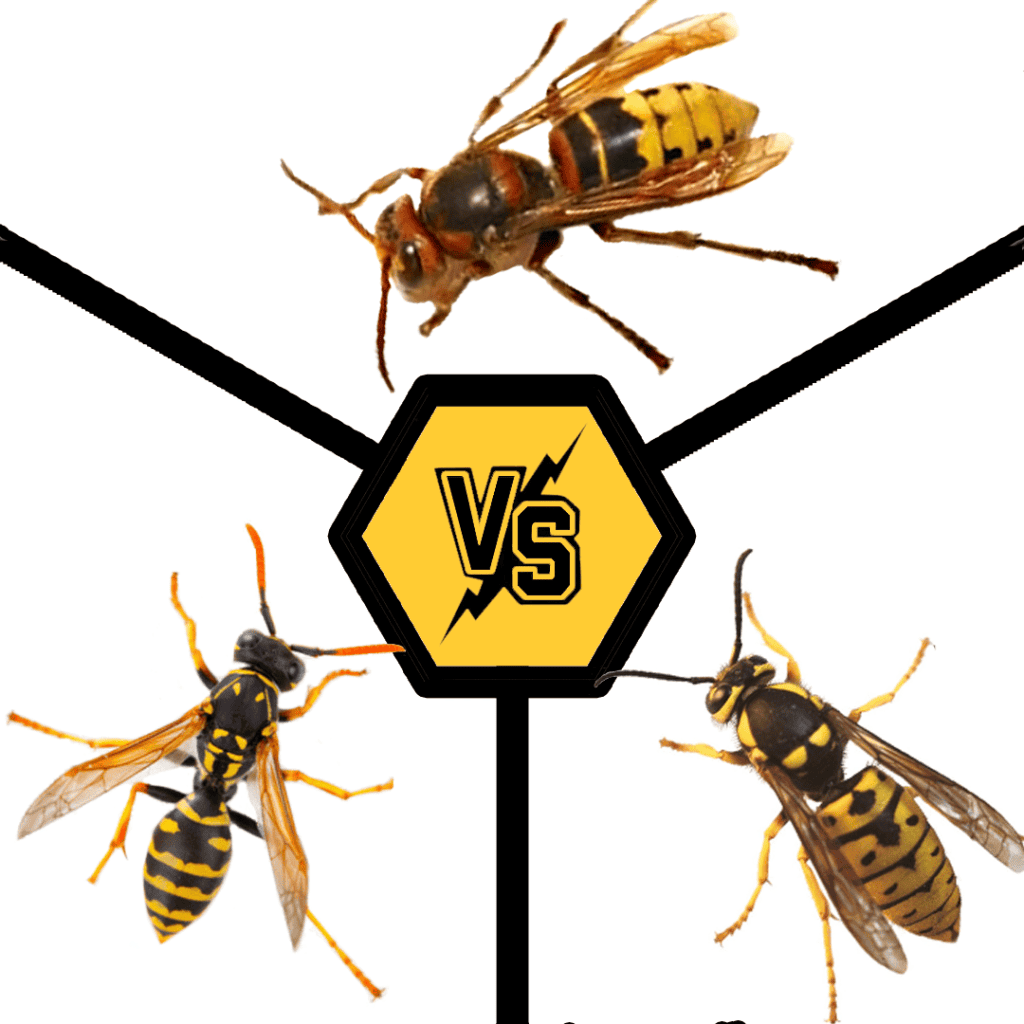
People use “wasp,” “hornet,” and “yellowjacket” as if they mean the same thing. When a nest shows up over your front door, the difference matters. All three are wasps. What changes is where they nest, how many live there, and how likely they are to sting when you get too close.
This guide shows how to tell them apart by body shape, nest, and behavior, with a focus on what New Yorkers are most likely to find under an eave, in a wall, or in a backyard.
What’s the Difference Between a Wasp, Hornet, and Yellowjacket?
All three are wasps. Yellowjackets are compact black-and-yellow wasps that often nest hidden or underground and defend aggressively. Paper wasps are slender, long-legged, and build open umbrella-shaped nests. True hornets, in the U.S. only the large European hornet, nest in hidden hollows. The bald-faced hornet, despite its name, is actually an aerial yellowjacket.
In everyday speech, “wasp” usually means a paper wasp, “hornet” means anything big or any large gray nest, and “yellowjacket” means the wasp crashing your picnic. That mix-up is why nests get misidentified. The most reliable clue is often not the insect but the nest.
Wasps vs. Hornets vs. Yellowjackets: Identification Table
The table below pulls together identification details from University of Maryland Extension and Cornell’s Integrated Pest Management program. The Maryland guidance covers Mid-Atlantic species that also occur in New York, and the Cornell guidance is specific to New York.
| Insect | Size | Body shape and color | Nest type and location | Aggression |
| Yellowjacket (eastern, German, common) | About 3/8 to 5/8 in | Compact body with a blunt abdomen close to the thorax, so no obvious thin waist. Bold black and yellow, with little body hair. | Paper envelope around the comb, usually hidden: underground in old rodent burrows, or in wall voids, attics, sheds, crawl spaces, and behind siding. Thousands of workers at peak. | High. Easily agitated, and vibrations near the nest can set it off. |
| Paper wasp (the European paper wasp is the most common in the Northeast) | About 5/8 to nearly 1 in | Slender with a thin waist and long legs that dangle in flight. Brown, reddish, or black and yellow. European paper wasps have orange-tipped antennae. | One open layer of comb shaped like an umbrella, no envelope, a few inches across, under eaves, door frames, shutters, and other sheltered spots. About 20 to 75 wasps. | Moderate. May bump an intruder as a warning, but stings if disturbed. |
| Bald-faced hornet (an aerial yellowjacket) | About 5/8 to 3/4 in for workers | Black with a white face and white markings. | Large gray, egg- or football-shaped enclosed paper nest hanging in the open, from trees and shrubs or at least 3 ft up on buildings. About 100 to 400 workers. | Very high if the nest is disturbed. |
| European hornet (the only true hornet in the U.S.) | About 3/4 to 1 3/8 in | Brick-red to brown with a golden-yellow abdomen and dark teardrop-shaped marks. | Tan, fragile, ragged paper nest hidden in hollow trees, barns, sheds, attics, or wall voids. About 200 to 400 workers, sometimes more. Flies at night and is drawn to lights. | Lower. Tends to avoid busy areas, but defends its nest. |
| Mud dauber (solitary wasp) | Slender, varies | Thread-thin waist. Usually black or blue-black, some with yellow markings. | No paper. Small tubes or lumps of dried mud on walls, porch ceilings, eaves, and sheds. No colony. | Low. Rarely stings. |
| Cicada killer (solitary wasp) | Among the largest wasps in New York | Very large and robust, often mistaken for a hornet. | Burrow in the ground. No colony. | Very low. Cornell calls them gentle giants. |
Mud dauber details come from general pest-management descriptions rather than the extension pages above.
Stinging Insect Identification in NYC: What You Are Most Likely to See
Cornell’s New York guidance says the European paper wasp has taken over much of the Northeast and is the most common paper wasp there, even though it is not native. Yellowjackets and bald-faced hornets are also familiar around homes, and the European hornet has lived in North America for well over a century. In summer you may also see a very large wasp hovering over a lawn. That is usually a cicada killer, not a hornet.
Nest Identification: Paper, Mud, or Underground?
Use this quick key. Look at the nest from a safe distance, not up close.
- An open umbrella of exposed cells under an eave, door frame, or railing: paper wasps.
- A large gray, enclosed nest shaped like an egg or football, hanging in open space: bald-faced hornet or another aerial yellowjacket.
- A tan, ragged paper nest hidden in a hollow tree, shed, attic, or wall, with big wasps bumping into lit windows at night: European hornet.
- A hole in the ground, or a gap in siding or a foundation, with steady traffic in and out: yellowjackets.
- Small tubes or lumps of dried mud on a wall or porch ceiling: mud daubers, which are solitary and rarely sting.
The building material is a clue too. Paper wasps, hornets, and yellowjackets all make nest paper by chewing wood fiber and mixing it with saliva, which is why their nests look gray or tan and papery. Mud daubers use mud instead. Social wasp colonies last only one year. Each winter the colony dies, only young queens survive, and old nests are not reused.
How Aggressive Is Each One?
Social wasps do not go looking for people to sting. According to University of Maryland Extension, they use their jaws to catch prey and use the stinger mainly to defend the nest or themselves. Trouble starts when something threatens the colony. Attacking wasps release an alarm pheromone that draws nestmates in, and even vibrations from a lawn mower or hedge trimmer near a nest can trigger a response.
University of Kentucky Extension entomologist Michael Potter calls yellowjackets arguably the most dangerous stinging insects in the United States and says bald-faced hornet nests can hold hundreds of wasps that are extremely aggressive when disturbed. Paper wasps are less defensive, and Cornell notes they often warn intruders by flying into them without stinging. Foraging wasps away from the nest rarely sting unless swatted or trapped against skin.
Late summer is when it gets worse. Colonies are at their largest, natural food gets scarcer, and yellowjackets scavenge at outdoor tables, trash cans, and sweet drinks. UMD notes that workers may also be more easily agitated as the colony’s social order begins to break down in autumn.
Is It a Wasp, a Bee, or Something Else?
Quick test: bees tend to be fuzzy, and wasps tend to look smooth. Cornell also points out that wasps can sting repeatedly, while honey bees sting once and leave the stinger behind.
Carpenter bees add to the confusion. They are often mistaken for bumblebees, but their shiny, hairless abdomen gives them away, and the clearest sign is a round, dime-sized hole in exposed wood with sawdust below. Our page on carpenter bee control explains what to look for. Honey bees and native bees are valuable pollinators, so confirm what you have before anything is killed.
When Are Wasps Active in NYC?
- Spring: Queens come out of hibernation, scout for sites, and start tiny nests alone.
- Summer: Workers take over building and foraging, and the colony grows.
- Late summer and fall: Colonies peak, and wasps become a nuisance at food and trash. This is when most stings happen.
- Winter: Freezing weather ends colony activity. Old nests are not reused.
That timeline comes from extension research covering the Mid-Atlantic and Northeast, and exact dates shift with the weather. Our NYC seasonal pest guide covers how stinging insects fit into the rest of the year, including why a small April nest can be a large July problem.
Are There “Murder Hornets” in New York?
No. As of University of Maryland Extension’s April 2026 update, the northern giant hornet had not been found in the United States outside Washington State, and yellow-legged hornet detections were limited to Georgia and South Carolina in 2023. A large, scary-looking insect in New York is far more likely to be a European hornet or a cicada killer. If you think you have found something unusual, send a clear photo to your local Cooperative Extension office.
Which Nests Can You Leave Alone, and Which Need a Pro?
Extension sources agree that not every nest has to come down. A nest that is high in a tree or far from foot traffic can often be left alone, since the colony dies off with cold weather. Where sources differ is on do-it-yourself removal. Cornell says small nests can sometimes be knocked down early in the season, while University of Kentucky and University of Maryland specialists warn that home remedies such as flooding a burrow, using a hose, or setting a nest on fire often lead to multiple stings. When in doubt, do not touch it.
Call a professional if any of these apply:
- The nest is underground, inside a wall, or in an attic, where you cannot see it
- It is near a door, walkway, play area, or any place people pass every day
- It is larger than a hand, or it is a yellowjacket or bald-faced hornet nest
- It is high up or hard to reach
- Anyone in the household has a known sting allergy, or you have been stung repeatedly
- European hornets are living in a wall void or attic
Two cautions from the extension specialists. If a nest is behind siding or in a wall, do not seal the spot where wasps are coming and going, because they can chew their way inward and show up indoors. And once a wall nest is dead, have the remnants removed, since dead larvae can attract flesh flies and rodents. Our guide on when to call pest control covers the general decision.
Is a Sting an Emergency?
Most stings cause pain, itching, redness, and local swelling. University of Kentucky Extension reports that roughly two million Americans, about one percent of the population, are hypersensitive to the venom, and that allergic reactions to wasp and hornet stings account for about 225,000 emergency room visits a year in the U.S.
Call 911 or get emergency care right away if someone develops hives, widespread itching, trouble breathing or swallowing, swelling of the face, throat, or mouth, dizziness, or a rapid pulse after a sting. Do not wait to see if it passes.
What to Do Right Now If You Find a Nest
- Keep your distance, and keep children and pets away from the area.
- Do not swat, spray, knock, or shine a flashlight at the nest, and do not mow or use loud tools near it.
- Take a photo from a safe distance with your zoom, and note whether the wasps are active during the day or at night.
- Cover food and drinks outdoors, and keep trash lids tightly closed.
- If the nest fits any of the situations above, call a professional.
Getting Help in NYC
If you are not sure what you have, or you have found a nest you do not want to deal with yourself, Pestonix can help. Our yellow jacket control service starts with locating the nest, whether it is aerial, in a wall void, or underground, and treating the colony at its source rather than just knocking down visible activity. Treatments are family-safe and pet-safe, backed by our 3-Month No-Pest Guarantee, with licensed technicians serving NYC and Long Island and 24/7 emergency support.
Contact our team to schedule an inspection, or browse our pest library to learn about other pests we handle.