
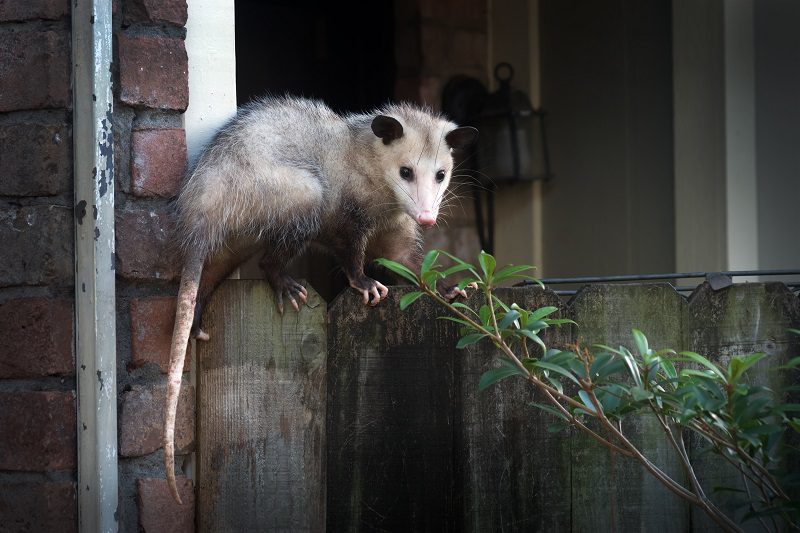
An opossum nosing through the trash at midnight, or a skunk crossing a Queens backyard at dusk, can be startling. Neither one means something is wrong. Most visits are short and harmless. The trouble starts when an animal moves in: denning under a deck, stoop, or shed, raising young, or getting into a basement or crawl space.
This guide covers what opossums in an NYC backyard are really like, how skunks differ, how real the rabies risk is, what you can do yourself, and when it makes sense to bring in a professional.
Should I Call an Exterminator for an Opossum or Skunk?
Usually not right away, and not for extermination. A lone opossum or skunk passing through a yard at night is normal and rarely a threat. Call a licensed wildlife professional if one is denning under your deck, shed, or house, is inside a building, has young, looks sick or injured, or has had contact with a person or pet.
The word “exterminator” is a little misleading here. Opossums and skunks are wildlife, not infestations. The goal is to get them out humanely and keep them out, not to kill them. New York State also has rules about what you can and cannot do with a trapped animal, covered below.
Opossums vs. Skunks: Behavior and Risk Compared
Both animals are common visitors, and both are often misunderstood. This table summarizes what the city’s own wildlife resources say about each.
| Virginia opossum | Striped skunk | |
| Size | About 28 inches long including the tail, around 8 pounds on average | 22 to 32 inches long, roughly 10 pounds, about the size of a house cat |
| Activity | Mostly nocturnal. Daytime sightings happen in cities and do not mean the animal is sick. | Mostly active at night and dawn. Daytime sightings happen in cities and do not mean the animal is sick. |
| Where they den | Temporary dens in tree hollows, logs, sewers, buildings, and dens left by other animals. They move around. | Burrows made by other animals, under buildings, and in hollow logs. Less active in winter but they do not hibernate. |
| What they eat | Almost anything: dead animals, fruit, insects, eggs, plus garbage, pet food, and bird feeders | Mostly insects in spring and summer, small mammals and birds in winter, plus plants, nuts, and trash and pet food |
| Main defense | Hissing, growling, showing teeth, or “playing possum” (an involuntary response that can last up to six hours) | Warns first by stomping, hissing, and arching its back, then sprays up to about 10 feet |
| Rabies | Very unlikely. Low body temperature makes infection difficult. | Possible. Skunks are the animal most likely to carry rabies in New York after raccoons, though only a few cases are confirmed in NYC each year. |
| Other risk to you | May bite or scratch if cornered | Spray can cause eye pain and temporary blindness, and the smell can linger for days |
| Upside | Efficient tick-eaters that also clean up carrion | Eat large numbers of insects in warm months |
| Overall | Low risk, often beneficial, usually a nuisance only when denning | Low risk if left alone, but spray and rabies make a den near your home worth handling |
Sources: WildlifeNYC species pages for Virginia opossums and striped skunks.
Opossums: mostly harmless, often helpful
Opossums are native to New York, shy, and built to avoid trouble. They forage at night, climb well, and rarely stay in one place for long. WildlifeNYC describes them as one of the few mammals that does not keep a permanent home as an adult, moving between temporary dens as food and water allow.
They do have a habit that alarms people. When frightened, an opossum may fall over and lie motionless with its mouth open. That is the “playing possum” response, and it is involuntary. If you see one, keep dogs and children away and give it space. It is not dead, and it will usually recover and wander off on its own.
Their appetite for ticks is a real plus, but it is not a tick plan. If ticks are a concern in your yard, see our guide to controlling ticks in your yard.
Skunks: the spray and rabies questions
Skunks are less common in the city, but they have been spotted across the boroughs, favoring open lots and grassy areas. They give warnings before spraying, so a stomping, hissing skunk is telling you to back off. The spray can reach about 10 feet and can sting or temporarily blind if it hits the eyes.
If a pet gets sprayed, the Humane Society has practical tips for de-skunking a dog. If a person gets spray in the eyes, rinse with clean water and see a doctor if irritation continues.
The New York State Department of Environmental Conservation notes that strong skunk odor on early fall nights is often tied to inadequate home maintenance and dogs left to roam at night, which can provoke skunks.
How Real Is the Rabies Risk in NYC?
It is real but small. According to the NYC Health Department, animal rabies in New York occurs mainly in raccoons, bats, and skunks, and raccoons are by far the most commonly reported. The last human rabies case in NYC was in 1947.
| Year | Rabid raccoons | Rabid skunks | Source |
| 2022 | 30 | 3 | NYC Health 2022 rabies summary |
| 2023 | 8 | 2 | NYC Health 2023 rabies summary |
| 2025 | 20 | 0 | NYC Health 2025 rabies summary |
| 2026 (through Oct. 5) | 24 | 5 | NYC Health press release, Oct. 5, 2026 |
Figures come from the NYC Health Department’s published summaries for 2022, 2023, 2025, and the October 2026 vaccination announcement. We left out 2024 because we did not find a summary for it. Those summaries list no rabid opossums.
What this means in practice:
- Do not touch, feed, or corner any wild animal.
- Keep dogs leashed and cats indoors, and keep pet rabies vaccinations current. They are required in NYC.
- If anyone is bitten or scratched, wash the wound thoroughly with soap and water, get medical care right away, and report the bite to the NYC Health Department. You can call 311 with questions.
- If a pet has contact with a skunk or any wild animal, call your veterinarian.
Seeing an animal in daylight is not proof of illness. WildlifeNYC points out that in urban areas with plenty of food and few predators, both species may forage during the day. Behavior that looks wrong, such as stumbling, circling, unusual aggression, or no fear of people, is a reason to keep your distance and call for help.
DIY Deterrents That Work
The best way to keep opossums and skunks away is to make your yard less useful to them. NYSDEC’s wildlife conflict tips organize this into steps, which we have adapted for NYC backyards.
Remove food. This is the biggest lever.
- Feed pets indoors, or bring bowls in at night
- Keep garbage secured and set it out only on collection day. Buildings with 1 to 9 units must use the official NYC Bin, per the Sanitation Department’s residential containerization rules
- Pick up fallen fruit and clean up spilled birdseed, or take feeders down for the warm months
Eliminate cover. Animals den where they feel hidden.
- Clear brush piles, logs, and junk, and stack firewood away from the house
- Keep tall grass trimmed near buildings
Put up barriers. Block the spots animals like best.
- Fence or screen the open space under decks, porches, and sheds. This is part of professional pest proofing and exclusion if you want it done to last
- Use chimney caps and covered vents, and repair gaps in foundations
- Seal entry holes only after you are sure nothing is inside, because sealing in an animal or its young leads to bigger problems
Excite or agitate. Motion-activated lights, noise, and similar scare tactics can nudge a visitor along, though animals may get used to them. Check noise rules first, and keep dogs on a leash instead of letting them chase wildlife.
Food left outside draws more than opossums and skunks. It also feeds rats, so securing it helps with both. Our rodent and wildlife management page explains how the two problems overlap.
What Not to Do
- Do not trap an animal and release it somewhere else. NYSDEC says it is illegal to move or relocate an animal off your property, including to a park, and that relocation can spread diseases such as rabies.
- Do not block a den without checking for young. Opossums breed from January through late March and again from mid-May to early July. Skunk kits are typically born in May and take about seven weeks to forage on their own.
- Do not use poison. Rodent poison is not a wildlife solution, and it can harm pets and other animals.
- Do not handle, corner, or move an animal that is playing dead, and do not pick up baby animals.
State rules also treat the two species differently when it comes to capturing or killing them. NYSDEC’s nuisance wildlife table shows a permit is needed to take a nuisance opossum, and sets conditions for skunks. Because the rules are specific, DEC directs anyone who needs an animal removed to a licensed Nuisance Wildlife Control Operator.
When to Call a Wildlife Expert
| Situation | What to do |
| One animal passing through at night, or seen briefly in daylight | Wait and watch. Secure food and keep pets away. |
| An opossum lying still on your lawn | Give it space and keep pets inside. It is likely playing possum and will leave on its own. |
| An animal denning under a deck, stoop, shed, or porch | Call a wildlife professional. Do not seal the space yourself. |
| Strong skunk odor near the foundation that keeps coming back | Call a wildlife professional. A skunk may be denning nearby. |
| An animal inside a basement, garage, crawl space, or attic | Call a wildlife professional. |
| Signs of babies, especially from late winter through early summer | Call a wildlife professional. Removal needs to account for young. |
| An animal that looks sick, injured, or unusually aggressive | Keep your distance, keep pets inside, and call for help. Call 311 with rabies questions. |
| A bite, scratch, or pet contact | Wash the wound, get medical care or call your vet, and report the bite to NYC Health. |
| Earlier DIY attempts have not worked | Call a wildlife professional. |
Not sure whether to keep trying on your own? Our guide to DIY versus professional pest control explains when it makes sense to switch.
What a Professional Wildlife Visit Involves
A good wildlife visit is more than trapping. It starts with an inspection to find where the animal is denning and how it got in, then humane removal, then sealing the structure so nothing moves back in. If droppings, nesting material, or odor are left behind, cleanup is part of the job too.
That is how Pestonix’s humane wildlife removal service works. It covers raccoons, squirrels, opossums, birds, bats, and skunks, using humane live trapping and permanent entry-point sealing with no poison. Most jobs take one to three visits. Whoever you hire, ask for their NYSDEC Nuisance Wildlife Control Operator license, which you can check through DEC’s license search.
Wildlife Control in NYC: Next Steps
If an opossum or skunk has settled in under your deck, stoop, or shed, or you are not sure what is making the noise or smell, you do not have to guess. Pestonix has served NYC and Long Island since 2004, with 24/7 emergency wildlife response across the NYC metro area. Contact our team to schedule an inspection, or call the NYC line at 917-913-6062 or the Long Island line at 631-560-2166.
For pets, the best protection starts with vaccination and prevention. Our guide to protecting your pets from common household pests covers the everyday parasite side of it.